TL;DR
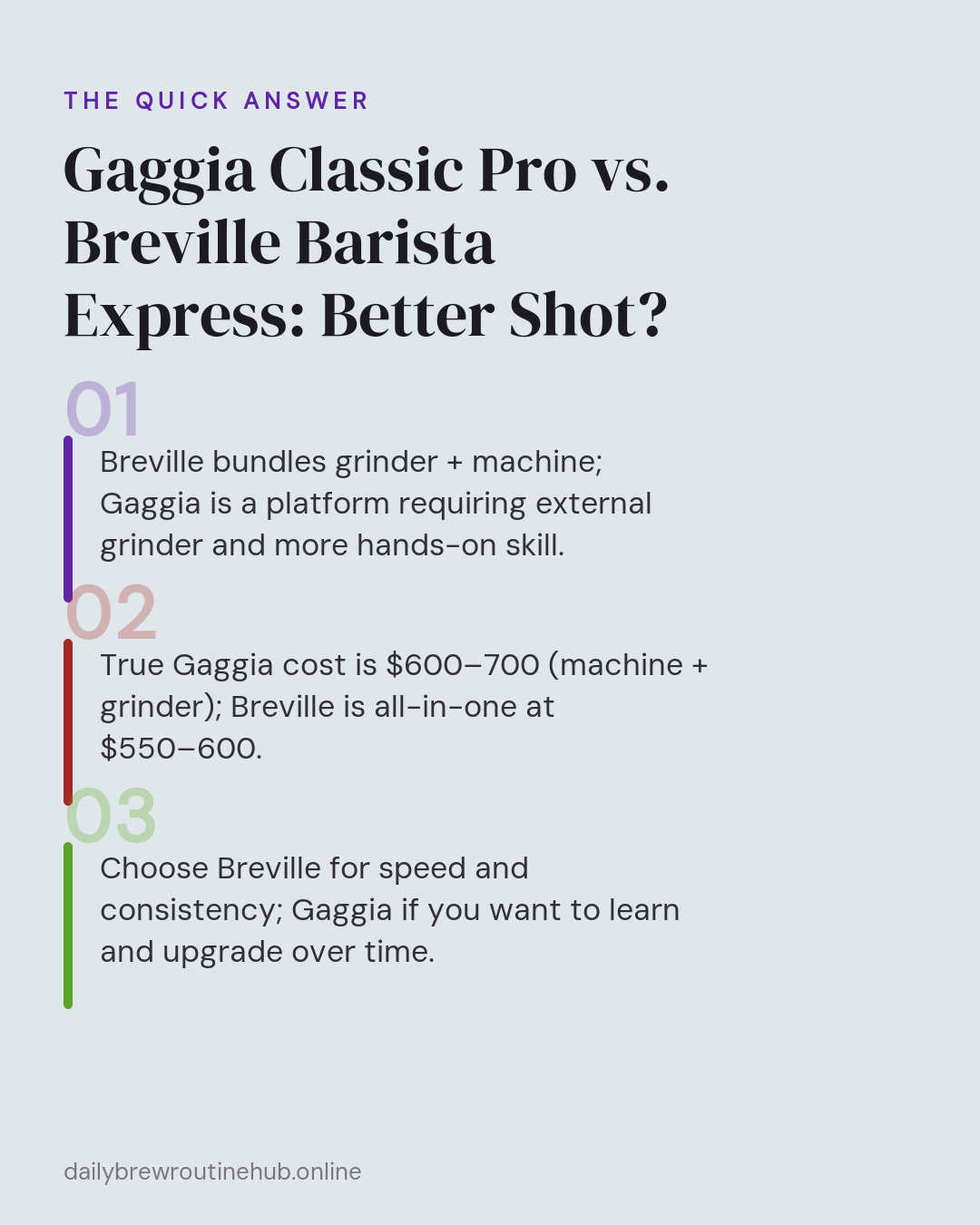
- Breville bundles grinder + machine; Gaggia is a platform requiring external grinder and more hands-on skill.
- True Gaggia cost is $600–700 (machine + grinder); Breville is all-in-one at $550–600.
- Choose Breville for speed and consistency; Gaggia if you want to learn and upgrade over time.
Gaggia Classic Pro vs. Breville Barista Express: Which Entry-Level Espresso Machine Actually Pulls a Better Shot?
You’ve got $400–$700 to spend on your first real espresso setup, and you’ve narrowed it down to two machines. Now you’re stuck in a Reddit rabbit hole at midnight, reading threads that somehow make the decision harder. Sound familiar?
The Gaggia Classic Pro and the Breville Barista Express dominate every beginner shortlist for a reason — they’re both genuinely good. But they solve different problems, suit different personalities, and they’ll shape your home espresso habit in completely different ways. This guide cuts through the spec-sheet noise and walks you through what daily life actually looks like on each machine, so you can choose based on your real workflow — not just what a chart tells you.
The Core Difference Most Guides Gloss Over
Most comparisons focus on pump pressure numbers and build materials. That misses the point.
The real difference is this: the Breville Barista Express is an espresso appliance. The Gaggia Classic Pro is an espresso platform.
The Breville bundles a conical burr grinder, pre-infusion, and a streamlined workflow into one unit. You plug it in, load beans, and pull a shot in under three minutes. It’s designed to get out of your way.
The Gaggia, on the other hand, hands you the controls and expects you to grow into them. It pairs with an external grinder. It rewards dialing in. It has a thriving aftermarket upgrade ecosystem. It’s designed to grow with you.
Neither is wrong. But they attract very different home baristas — and if you pick the wrong one for your personality, you’ll resent it within six months.
Gaggia Classic Pro: What the Daily Routine Actually Looks Like
The Gaggia Classic Pro runs a 3-way solenoid valve and a vibration pump, which is standard for this price range. The machine itself retails around $450, but here’s the honest catch: you need a separate grinder. A capable burr grinder — something like a Baratza Encore or similar entry-level flat burr unit — adds another $150–200. Your real cost of entry is closer to $600–$700.
Here’s what a typical morning pull looks like on the Gaggia:
- Flip the machine on and wait. The Gaggia needs a warm-up period — most owners run a blank shot or leave it on for 10–15 minutes before pulling. Without a PID controller (a popular aftermarket mod), temperature consistency is something you manage by feel and habit.
- Grind fresh into the portafilter. Your external grinder does the heavy lifting here. Dose around 18–19g for a double shot.
- Tamp. The Gaggia doesn’t assist with this — it’s on you. A flat, level 30-pound tamp makes a real difference.
- Lock the portafilter and pull. Target 25–30 seconds for a 36–40ml yield. No automated pre-infusion here; you control everything by timing and observation.
- Steam your milk separately. The Gaggia’s steam wand works well but requires technique — you’re learning proper microfoam, not relying on a frothing shortcut.
Total routine: roughly 3–5 minutes when you factor in warm-up. It’s a ritual. If that sounds tedious, the Gaggia might frustrate you. If that sounds satisfying, you’ll love it.
The upgrade angle is real. A PID controller mod runs $40–80 and meaningfully tightens temperature stability. Upgraded baskets (IMS or VST precision baskets) improve extraction evenness. The OPV (over-pressure valve) can be adjusted to reduce pump pressure from 9 bar, which specialty reviewers note helps with certain light roasts. The Gaggia’s modular design actively supports this tinkering — it’s half the appeal for gear-minded home baristas.
Breville Barista Express: What the Daily Routine Actually Looks Like
The Breville Barista Express retails around $700 and bundles everything: integrated conical burr grinder, pre-infusion, a 67oz water tank, and a pressurized-to-unpressurized basket system. Breville Barista Express Espresso Machine
Here’s a typical morning on the Breville:
- Load beans into the hopper. The integrated grinder is right there — no separate unit, no extra counter space.
- Dial the grind setting and dose. A built-in timer controls grind duration. The machine tamps for you with a trim and tamp tool assist (though you still apply pressure manually).
- Pull the shot. Pre-infusion kicks in automatically, gently saturating the puck before full pressure engages. This meaningfully reduces the risk of channeling, which is one of the most common beginner extraction problems.
- Steam your milk. The Breville’s steam wand is more powerful and more forgiving than the Gaggia’s for beginners.
Total routine: 2–3 minutes. No separate warm-up ritual required (though giving it 5 minutes does help). It’s genuinely fast on weekday mornings.
The integrated grinder has a real trade-off, though. Conical burr grinders in all-in-one machines retain some coffee grounds between doses — a known issue for freshness and single-origin workflows. If you’re pulling light, single-origin roasts where every gram counts, you’ll notice flavor inconsistency more. For medium or dark roasts in a daily hopper workflow, it’s largely a non-issue.
Shot Quality: The Honest Answer
Here’s what specialty reviewers and the home espresso community consistently report — and it’s worth being transparent that this is reviewer consensus, not laboratory data:
Gaggia Classic Pro, dialed in with a quality external grinder, tends to produce sharper, more defined espresso with better crema separation. The manual control means a skilled operator can extract at a higher ceiling. When you pair it with a good standalone grinder, the grind quality is at least equal to — and often better than — the Breville’s built-in unit.
Breville Barista Express produces consistently good shots with less skill required. The pre-infusion reduces extraction errors. The integrated grinder ensures dose consistency within the same bag of beans. For the first 50–100 shots, most beginners will pull better espresso on the Breville simply because there are fewer variables to mis-manage.
The gap? It’s subtle early on and widens with experience. Once you’ve pulled 200+ shots on the Gaggia with proper technique, reviewers broadly agree the shot quality ceiling is higher. But if you never develop the habit of dialing in carefully, the Breville will quietly outperform an under-optimized Gaggia every single day.
Neither machine has been shown to “objectively” pull better espresso in any published laboratory testing. Any claim otherwise is someone’s well-informed opinion — including this post. Take both machines’ reputations as exactly that: the accumulated experience of thousands of home baristas, not scientific certainty.
The Grinder Is the Real Variable Here
This point gets buried in most comparisons, but it changes everything.
If you pair a Gaggia Classic Pro with a low-quality grinder, it will pull worse shots than a Breville Barista Express every time. The machine can only work with what the grinder delivers.
When you spend $600–$700 total on a Gaggia plus a quality grinder, specialty reviewers broadly agree that setup outperforms a standalone Breville Barista Express at the same price. But at equal total spend, they’re closer than you’d expect.
The Breville at $700 is essentially buying a machine and a grinder together. If you’re not ready to spend $150–200 more on a grinder, the Breville makes honest financial sense.
Long-Term Investment: Where Each Machine Wins
Gaggia Classic Pro has a strong track record for longevity. Ownership reports from the home espresso community — particularly on forums like r/espresso — frequently mention machines running reliably for 10+ years with basic maintenance. The modular design means worn parts are replaceable, not a reason to junk the whole machine.
Breville Barista Express tends to have a shorter reported lifespan, with estimates from reviewers typically in the 5–8 year range. It’s also harder to upgrade — the proprietary portafilter limits aftermarket basket options, and there’s no thriving mod community the way Gaggia has.
If you want a machine that grows with your skill level over years, the Gaggia is the stronger long-term bet. If you want three to five years of reliable, low-maintenance espresso before you’re ready to step up to a proper prosumer setup anyway, the Breville delivers on that entirely reasonably.
Maintenance Reality
Neither machine is high-maintenance, but they demand different habits.
Gaggia: Back-flush the group head regularly, descale every few months, and flush before and after shots. The water tank is on the small side — you’ll refill it more often. It’s a simple routine, just manual.
Breville: The larger water tank is genuinely convenient. The bigger maintenance habit is the integrated grinder — conical burrs accumulate fine coffee oils and need regular cleaning to prevent retention and staling. Skip this and your espresso will taste progressively stale even with fresh beans.
Winner for pure convenience: Breville. Winner for learning how espresso actually works: Gaggia.
Final Verdict: Which One Should You Buy?
There’s no single right answer, but there is a right answer for you — and here’s how to find it:
Buy the Breville Barista Express if:
– You want espresso on weekday mornings without a 5-minute ritual
– You’re new to espresso and want confidence in your technique before dialing in
– Your total budget is under $700 and you don’t want to buy a separate grinder
– You prefer repeatable, consistent results over maximum shot ceiling
Buy the Gaggia Classic Pro if:
– You enjoy the process of dialing in and improving your technique
– You’re willing to invest in a separate grinder and a modest upgrade or two
– You want a machine that can genuinely grow with you for 10+ years
– You already have (or plan to buy) a quality standalone burr grinder
My honest take: the Gaggia Classic Pro is the better espresso platform, and the Breville is the better espresso experience for most beginners. They’re not really competing for the same person once you look past the price tag.
If you see espresso as a hobby and want to keep developing your technique, the Gaggia’s upgrade path and shot ceiling will reward you. If espresso is the fuel that gets you through Monday mornings and you want it to just work, the Breville is hard to argue with.
Interested in dialing in your grind workflow? Check out our guide to choosing a standalone burr grinder for home espresso, or explore our French press and pour-over routines if you’re building a full home brew setup.
Sources
- Breville Barista Express vs Gaggia Classic Pro – LifeStyle Lab
- Gaggia Classic Pro Vs Breville Barista Express: The Rundown
- Gaggia Classic Pro vs Breville Barista Express | Acquired Coffee
- Gaggia Classic Pro vs Breville Barista Express: Which Espresso Setup Should You Buy? — HomeCoffeeStack
- Gaggia Classic Pro vs Breville Barista Express in 2026
- Breville Barista Express vs. Gaggia Classic Pro: Which Should You Actu – PURE EARTH COFFEE