TL;DR
- Superautomatic machines handle everything (grind, tamp, brew) at one button; semi-automatic gives you manual control for $300–$1,500 entry cost.
- Superautomatic machines deliver consistent 7–8/10 quality but have a fixed ceiling; semi-automatics let you dial in and experiment endlessly.
- Semi-automatics dominate coffee shops and serious home setups because the manual control mirrors professional espresso technique.
Superautomatic vs. Semi-Automatic Espresso Machines: Which One Fits How You Actually Make Coffee?
Choosing between a superautomatic and a semi-automatic espresso machine is really choosing between two completely different morning routines — and picking the wrong one is one of the most common (and expensive) mistakes home coffee drinkers make.
One machine asks almost nothing of you. The other asks you to become something of a craftsperson. Both can produce excellent espresso — but only when they’re matched to the right person. Here’s how to figure out which one that is.
The Real Difference Isn’t Just “Automatic vs. Manual”
Most comparisons get this wrong by framing it as a convenience vs. quality debate. It’s more nuanced than that.
A superautomatic espresso machine handles every step for you: grinding, dosing, tamping, and brewing happen at the press of a single button, and your espresso lands in the cup in about 60 seconds. A semi-automatic gives you the pump and boiler — you handle everything else, from the grind to the tamp to stopping the shot at the right moment.
The result? Semi-automatic machines are actually the most common setup in homes and coffee shops precisely because that level of manual control is what professional espresso is built on. Superautomatic machines are built around a different value entirely: removing that process from your morning altogether.
Neither approach is wrong. But they lead to genuinely different daily lives.
What a Superautomatic Actually Does (And What It Can’t)
Imagine pouring beans into a hopper on Sunday night and not thinking about grinding again until next week. You wake up, press a button, and espresso — or a latte, if your model includes a frother — is ready in about a minute.
That’s the superautomatic promise, and it delivers on it. The machine manages grind size, dose, tamp pressure, and extraction. Some models even steam and texture milk automatically. The learning curve is genuinely minimal: most users are comfortable and consistent within a few days.
The trade-off is in the ceiling, not the floor. Superautomatic machines deliver consistent results — industry experts often describe this as a reliable 7–8 out of 10 from day one. But that ceiling is fixed. If you want to adjust extraction time, dial in a finer grind for a specific bean, or experiment with dose weight, your options are limited by whatever the machine allows in its settings menu.
There’s also a cost-of-ownership consideration worth knowing: superautomatic machines start around $700–$1,000 at the quality tier where they produce decent espresso, and they go well past $3,000 for top-tier models. When service is needed, repairs tend to be more complex and expensive than with simpler semi-automatic machines. Average lifespan sits at 5–8 years under regular use.
What a Semi-Automatic Asks of You (And Gives Back)
A semi-automatic espresso machine is the workhorse of the coffee world, but it won’t do your job for you.
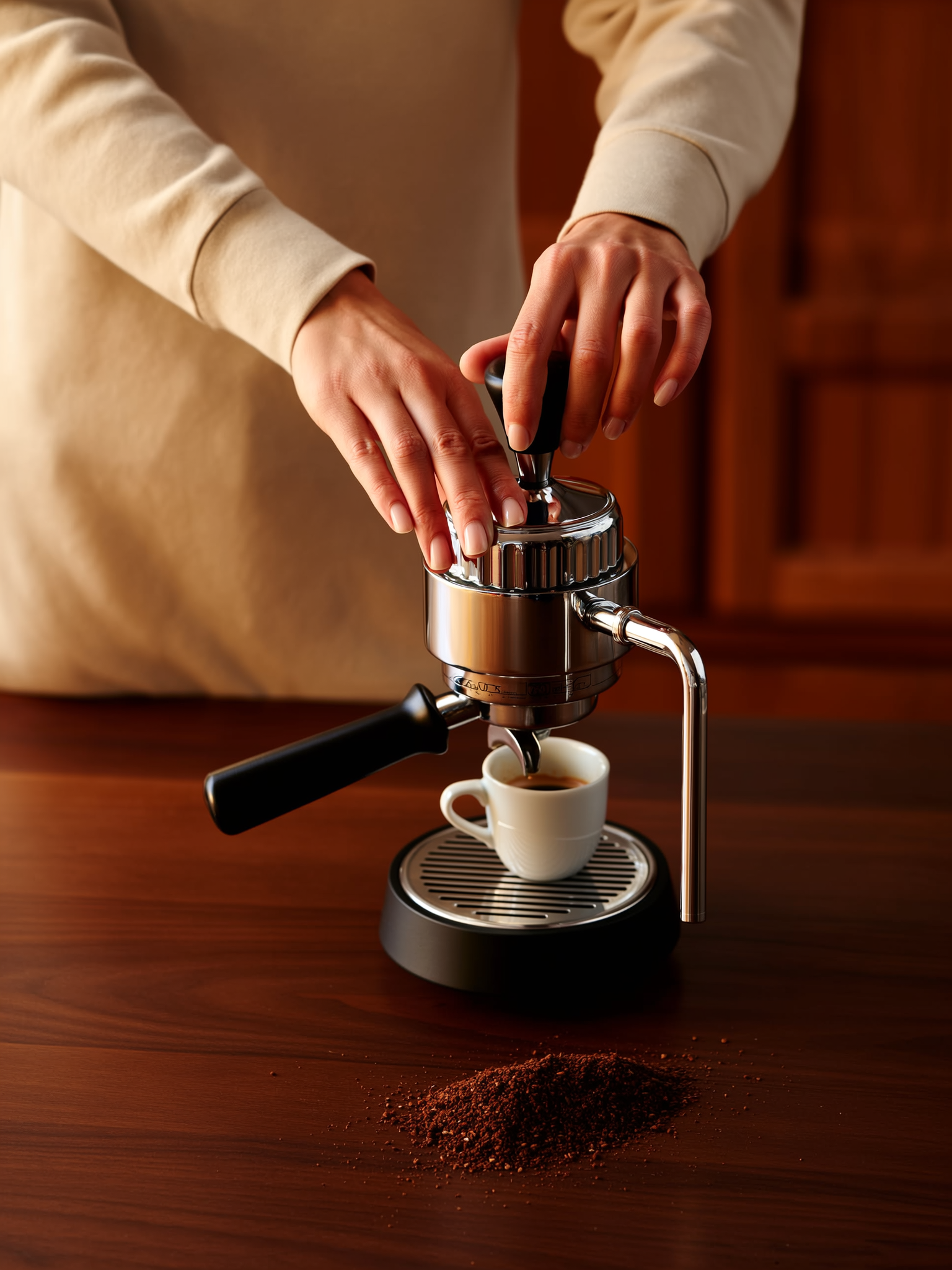
Your morning workflow looks like this: grind fresh beans to a medium-fine consistency, distribute the grounds evenly in the portafilter, tamp with consistent downward pressure, lock the portafilter into the group head, watch the pour, and stop the shot manually when you’ve hit your target volume. From grinding to cleanup, this typically takes 5–10 minutes per drink.
What you get in return is genuine control. Grind coarser and extraction slows, which changes flavor balance. Adjust your dose up or down and the body of the shot shifts. Dial in your tamp pressure and you’re influencing how evenly water moves through the puck. These aren’t abstract tweaks — you taste every one of them in the cup.
Entry-level semi-automatic machines start around $300–$500. You’ll also need a separate grinder, which adds another $200–$400 at a quality level worth buying. That’s a higher upfront investment than it might look, but semi-automatics regularly last 10–20+ years, and maintenance is typically more straightforward and less costly than superautomatic repairs.
At comparable price points, experts consistently note that a semi-automatic paired with a good grinder will produce better-tasting espresso than a superautomatic. That said, early results for beginners often start at a 5–6 out of 10 — there’s a real learning phase before you’re consistently pulling shots you’re proud of.
The Learning Curve: What to Actually Expect Week by Week
Here’s what most guides gloss over: the semi-automatic learning curve is real, but it’s manageable and, for most people who choose this path, genuinely enjoyable.
Research from equipment experts puts the timeline like this:
- Weeks 1–2: You’re building muscle memory for tamping pressure and learning to read your pour. Shots will be inconsistent — too fast (under-extracted, sour), then too slow (over-extracted, bitter). This is normal.
- Weeks 2–4: Basic consistency starts to emerge. You’ll learn what a 25–30 second extraction looks like for your beans, and you’ll recognize when something is off before you even taste the shot.
- Months 1–3: Milk steaming, extraction timing refinements, and experimenting with different beans become accessible. This is where semi-automatic brewing becomes genuinely satisfying rather than just educational.
Most home baristas describe this period as enjoyable rather than frustrating — provided they actually want to learn. If you’re not interested in the process, this timeline just reads as “three months before my espresso is reliably good,” which is a fair reason to choose a superautomatic instead.
Five Questions That Will Actually Tell You Which Machine Fits Your Life
Forget the spec sheets for a moment. Answer these honestly:
1. Do you have 10–15 minutes most mornings, and do you want to spend part of it on coffee?
If yes — and the word “want” is doing real work there — a semi-automatic will reward you. If you’d resent the time, a superautomatic removes that friction entirely.
2. Is your morning genuinely chaotic?
Busy parents, commuters, shift workers, anyone making coffee for multiple people before 7 a.m.: a superautomatic’s 60-second button press isn’t a luxury, it’s practically necessary. No judgment — it’s a lifestyle match, not a character test.
3. Are you willing to learn to troubleshoot?
Semi-automatic machines require you to diagnose problems: a shot running too fast, a portafilter that isn’t sealing, a grinder that needs calibrating. Superautomatic machines handle internal maintenance more autonomously, though at the cost of complexity when they do break down.
4. What’s your honest budget?
A superautomatic that produces genuinely good espresso starts around $700–$1,000. A semi-automatic setup (machine + grinder) that produces excellent espresso is available for $500–$900 total. If budget is tight, the semi-automatic path actually has more room at the lower end — though you’ll need to factor in the grinder.
5. Do you want this to be a hobby or just a function?
This is the core question. A superautomatic treats espresso as a task. A semi-automatic makes it a practice. Both are completely valid ways to have coffee in your home.
The Honest Answer: Which One Should You Actually Buy?
Neither machine type wins in the abstract — only in context.
A person who loves the ritual of morning coffee, has time to spare, and wants to develop real barista skill will be deeply frustrated by a superautomatic’s locked settings within six months. A person who needs caffeine in hand before their workday starts and has zero interest in extraction variables will abandon a semi-automatic within the same timeframe.
Here’s the practical guidance, based on where most buyers actually land:
If you’re new to espresso: Consider starting with a semi-automatic, even if the learning curve sounds intimidating. The skills you build — reading a pour, dialing in a grind, understanding extraction — make every future brewing routine more rewarding, regardless of what machine you end up on later. The investment in knowledge compounds.
If you’re upgrading from a budget superautomatic and want noticeably better quality: A mid-range semi-automatic paired with a quality burr grinder burr coffee grinder for espresso is the most practical next step. You’ll spend roughly the same as a mid-tier superautomatic replacement, get a higher quality ceiling, and likely extend your equipment’s useful life significantly.
If convenience is genuinely non-negotiable: Buy the best superautomatic your budget allows in the $700–$1,500 range. Don’t buy a budget superautomatic expecting to match semi-automatic quality — at the low end, you get the worst of both worlds.
One Thing Most Guides Get Wrong
Almost every comparison article implies that buying a semi-automatic is the “serious” choice and a superautomatic is for people who don’t really care about coffee. That framing is unhelpful and inaccurate.
A superautomatic machine at a quality price point, maintained well, and loaded with freshly roasted beans will produce consistently good espresso that most coffee drinkers will genuinely enjoy every morning. That’s not a consolation prize — it’s a deliberate, smart match for a specific lifestyle.
The mistake isn’t choosing the “wrong” machine type. The mistake is choosing based on what sounds most impressive rather than what fits how you actually live and how you actually want to spend your mornings.
The Bottom Line
Superautomatic espresso machines are for people who want excellent convenience, consistent results from day one, and minimal time investment — and who are comfortable with a fixed quality ceiling and higher upfront cost.
Semi-automatic espresso machines are for people willing to invest 2–4 weeks in a real learning curve, who want the highest possible quality ceiling, and who find the brewing process itself satisfying rather than burdensome.
The best espresso machine is the one you’ll actually use every morning for years. Start there.
Frequently Asked Questions
Is a superautomatic espresso machine worth it?
Superautomatic machines are worth it if you prioritize speed and minimal decision-making over dialing in and experimentation. They deliver consistent 7–8/10 quality, cost $700–$3,000+, and require more expensive repairs than semi-automatics, so match the purchase to your actual daily routine, not your aspirations.
Can a superautomatic espresso machine make good espresso?
Yes, superautomatic machines produce good, consistent espresso—but within a fixed quality ceiling. They can’t match the flexibility of semi-automatics for dialing in grind size, dose, or extraction time, so quality tops out at reliable rather than exceptional.
What’s the difference between a superautomatic and semi-automatic espresso machine?
A superautomatic handles grinding, dosing, tamping, and brewing at the press of one button; a semi-automatic provides the pump and boiler only, leaving you to grind, dose, tamp, and stop the shot manually. Semi-automatics cost less upfront, last longer, and give you full control—superautomatics trade control for speed and consistency.
How long do superautomatic espresso machines last?
Superautomatic machines typically last 5–8 years under regular use, with repairs tending to be more complex and expensive than semi-automatic models due to the built-in grinding and dosing components.
Sources
- Super-Automatic vs. Semi-Automatic Espresso Machine – Full Comparison
- Espresso Machines: Semi-Automatic Vs. Super-Automatic Vs. More
- Zulay Kitchen Automatic vs Super Automatic Espresso Machine
- Comparison of Espresso Machine Types – Super Automatic, Automatic, …
- Super-Automatic vs Semi-Automatic: The Quality vs Convenience …
- Super-Automatic vs Semi-Automatic Espresso Machines