TL;DR
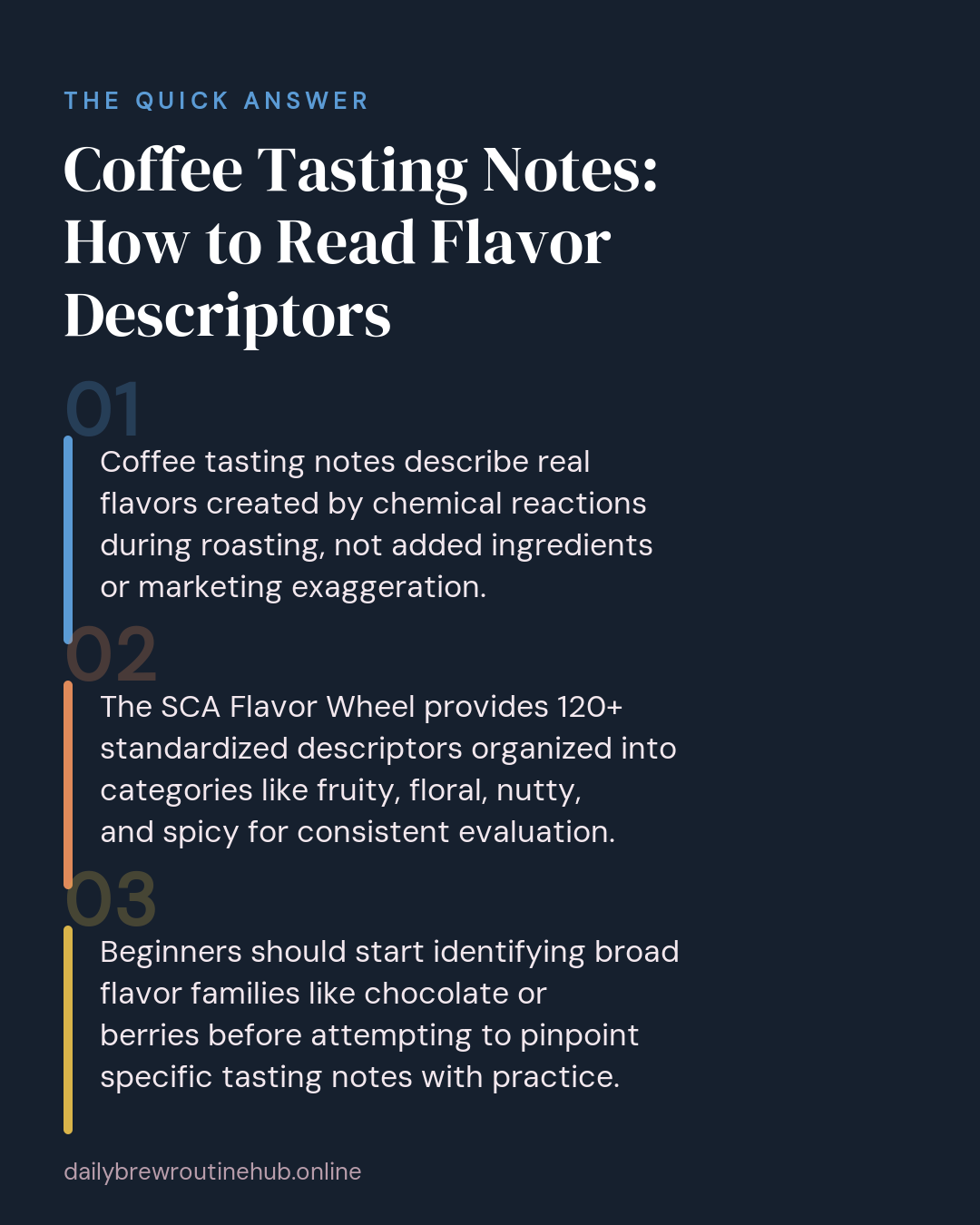
- Coffee tasting notes describe real flavors created by chemical reactions during roasting, not added ingredients or marketing exaggeration.
- The SCA Flavor Wheel provides 120+ standardized descriptors organized into categories like fruity, floral, nutty, and spicy for consistent evaluation.
- Beginners should start identifying broad flavor families like chocolate or berries before attempting to pinpoint specific tasting notes with practice.
Understanding Coffee Tasting Notes: How to Read Them
If you’ve ever picked up a bag of specialty coffee and squinted at the label — “notes of blackcurrant, hibiscus, and brown sugar” — you’re not alone in feeling mildly confused. Are those flavors added? Is someone being overly poetic? Or is that actually what’s in your cup?
The short answer: it’s genuinely in the coffee. Tasting notes are a real, structured language, and once you learn to decode them, you’ll never look at a coffee bag the same way again.
What Are Coffee Tasting Notes, Really?
Tasting notes are flavor descriptors assigned to a specific coffee lot by trained tasters called cuppers. These aren’t marketers throwing words at a wall — they’re professionals who evaluate coffee through a standardized process called cupping, where they sniff, slurp, and spit their way through dozens of samples to identify the dominant and subtle flavors in each batch.
The reference framework they use is the SCA (Specialty Coffee Association) Flavor Wheel, which lists over 120 flavor descriptors organized into recognizable categories. It’s the closest thing coffee has to a universal taste dictionary.
What makes this more than guesswork is chemistry. During roasting, green coffee beans undergo a complex series of reactions — Maillard reactions, caramelization, Strecker degradation — that produce hundreds of aromatic compounds. Some of those compounds genuinely mirror the chemical structures found in blueberries, jasmine, or dark chocolate. When a roaster writes “notes of dark cherry,” they’re pointing to real compounds in that cup that trigger the same sensory response as dark cherry.
So no, nothing is added. It’s all already there, waiting for you to find it.
The SCA Flavor Wheel: Your Beginner’s Map
Think of the SCA Flavor Wheel as a map with broad territories and detailed neighborhoods. The outer ring gets increasingly specific; the inner categories are broad families.
The major flavor families you’ll encounter include:
- Fruity — berry, citrus, stone fruit, tropical
- Floral — jasmine, rose, chamomile
- Nutty / Cocoa — almond, hazelnut, dark chocolate, caramel
- Spicy — pepper, clove, anise
- Fermented / Winey — boozy, vinegar-adjacent (common in some natural-process coffees)
- Green / Vegetal — grassy, herbal (often a sign of underdevelopment during roasting)
When you’re starting out, don’t stress about identifying the exact sub-note. Start with the broad category. Does this taste fruity or chocolatey? That’s enough. Specificity develops with practice.
The most beginner-friendly notes to look for are chocolate, caramel, nuts, berries, and citrus. These are strong enough to identify even on your first few attempts, and they give you an anchor for building your vocabulary outward.
How Roast Level Changes Everything You Taste
Here’s something that trips up a lot of new coffee drinkers: the same bean can taste completely different at different roast levels. Roast level is one of the biggest influences on what ends up in your cup.
-
Light roasts spend less time in the roaster, which preserves more of the origin’s natural character. Expect bright acidity, fruity or floral notes, and a lighter body. If your bag says “jasmine, lemon, peach,” it’s almost certainly a light roast.
-
Dark roasts develop what roasters call “roast-driven” flavors — the heat transforms the bean’s original compounds into deeper, bolder profiles like dark chocolate, smoke, molasses, and toasted nuts. The origin character largely disappears behind these roast flavors.
-
Medium roasts sit in between, balancing origin notes with roast development. They’re an excellent entry point for learning to taste because you get both worlds in one cup.
To put this in practical terms: take a single-origin Ethiopian bean. At a light roast, it might read as “blueberry, bergamot, floral.” Roast that same bean darker, and you’d get “dark chocolate, earthy, low acidity.” Same bean. Completely different experience.
This is why checking the roast level alongside the tasting notes isn’t optional — it’s half the story.
The Main Flavor Families and What They’re Telling You
Once you can match flavor families to their likely origins, tasting notes stop feeling abstract. Here’s a quick decoder:
Fruity Notes (Berry, Stone Fruit, Tropical)
Fruity flavors typically signal higher acidity and often come from specific growing conditions and processing methods. Ethiopia and Kenya are famous for these profiles — think blueberry and blackcurrant in Ethiopian naturals, or bright grapefruit in Kenyan washed coffees. Natural and honey processing methods, where the fruit pulp dries on the bean, intensify fruity notes significantly.
Nutty and Chocolate Notes
These are your comfort-zone flavors, and they tend to emerge from medium to darker roasts and beans grown at lower elevations with earthier soil profiles. Brazil, Colombia, and Guatemala are frequent sources. If you see “hazelnut, milk chocolate, brown sugar,” you’re probably looking at something medium-roasted, lower-acidity, and very approachable.
Floral and Tea-Like Notes
Delicate floral notes — jasmine, rose, hibiscus, chamomile — are a hallmark of East African coffees at lighter roasts, particularly Ethiopian Yirgacheffe. The terroir (soil, altitude, climate) of certain regions genuinely produces compounds that mirror floral aromatics. If you’ve ever brewed a light Ethiopian and thought it smelled like a cup of tea, that’s not your imagination.
How to Actually Read the Notes on a Coffee Bag
Not all bags are created equal. Here’s how to extract real information from what’s printed on the label:
The order of notes matters. Roasters typically list tasting notes in order of prominence. The first one or two descriptors are what you’re most likely to detect clearly; the ones at the end are subtle background flavors that require a more trained palate to pick out. If the bag says “caramel, dried fruit, rose,” focus on caramel first.
Freshness is everything. Tasting notes are most vivid and accurate within 2 to 4 weeks of the roast date. After that, CO₂ off-gassing slows, aromatics fade, and the cup starts tasting flat. Always check the roast date, not just the “best by” date. A bag roasted eight months ago won’t taste like its label promises.
Cross-reference three things: origin, processing method, and roast level. They should align with the notes listed. Here’s a quick sanity check:
- Natural-process Ethiopian? Should hint at fruit, fermentation, or florals.
- Washed Colombian medium roast? Expect chocolate, nuts, mild citrus.
- Dark-roasted Sumatra? Earthier, fuller body, low acidity.
If the notes seem wildly mismatched with origin and processing, either the roaster is being aspirational or the batch is a blend worth investigating further.
Building Your Own Palate: Where to Actually Start
You don’t need professional training to develop a useful coffee palate. What you need is consistency, curiosity, and a bit of structure.
Do side-by-side comparisons. Brewing two different coffees back to back in the same method is the fastest way to train your senses. Contrast sharpens perception — you’ll notice the fruity brightness far more clearly when it’s sitting next to a chocolatey, earthy cup.
Keep a simple tasting journal. It doesn’t need to be elaborate. Just jot down:
– Bean name and origin
– Roast level
– Brew method
– 2–3 flavors you notice (even vague ones — “something sweet,” “kind of tangy”)
Patterns emerge quickly. You’ll start recognizing your preferences and what signals to look for in descriptions.
Try cupping at home. Cupping is the tasting method professionals use, and it’s surprisingly accessible. Grind your coffee medium-coarse, add it directly to a cup, pour hot water over it, wait four minutes, then break the crust — push through the floating grounds with a spoon — and slurp a spoonful loudly. The aeration spreads the liquid across your palate and amplifies flavors. It feels absurd the first time. It works remarkably well.
Use reference foods as anchors. When you’re tasting something and a note seems just out of reach, think in everyday comparisons. Does this remind me of anything at breakfast? A fruit I’ve eaten? A baked good? Your flavor memory is more developed than you think — it just needs prompting.
From Notes to Your Next Brew
Understanding tasting notes isn’t about becoming a coffee snob. It’s about knowing what you actually like and being able to shop for it confidently.
Next time you’re at a coffee shop or scrolling through an online roaster’s offerings, you’ll look at “notes of blueberry, dark chocolate, and jasmine” and immediately start processing: light roast, probably East African, natural or washed process. You’ll know whether that sounds like your kind of cup before you spend a cent.
Your palate develops with every brew. You won’t catch every note at first — and that’s genuinely fine. Even experienced tasters disagree on specific descriptors. The goal isn’t perfection; it’s building a working vocabulary that helps you navigate the extraordinary variety of flavors that different coffees can offer.
Start simple. Taste often. Write a few things down. And the next time a bag mentions hibiscus and stone fruit, you’ll nod knowingly instead of squinting at the label.
Want to put your tasting knowledge into practice? Check out our guides on brewing methods that highlight origin flavors and how to choose coffee beans by roast level to bring these flavor notes to life in your own kitchen.
Photo by Jon Tyson on Unsplash