TL;DR
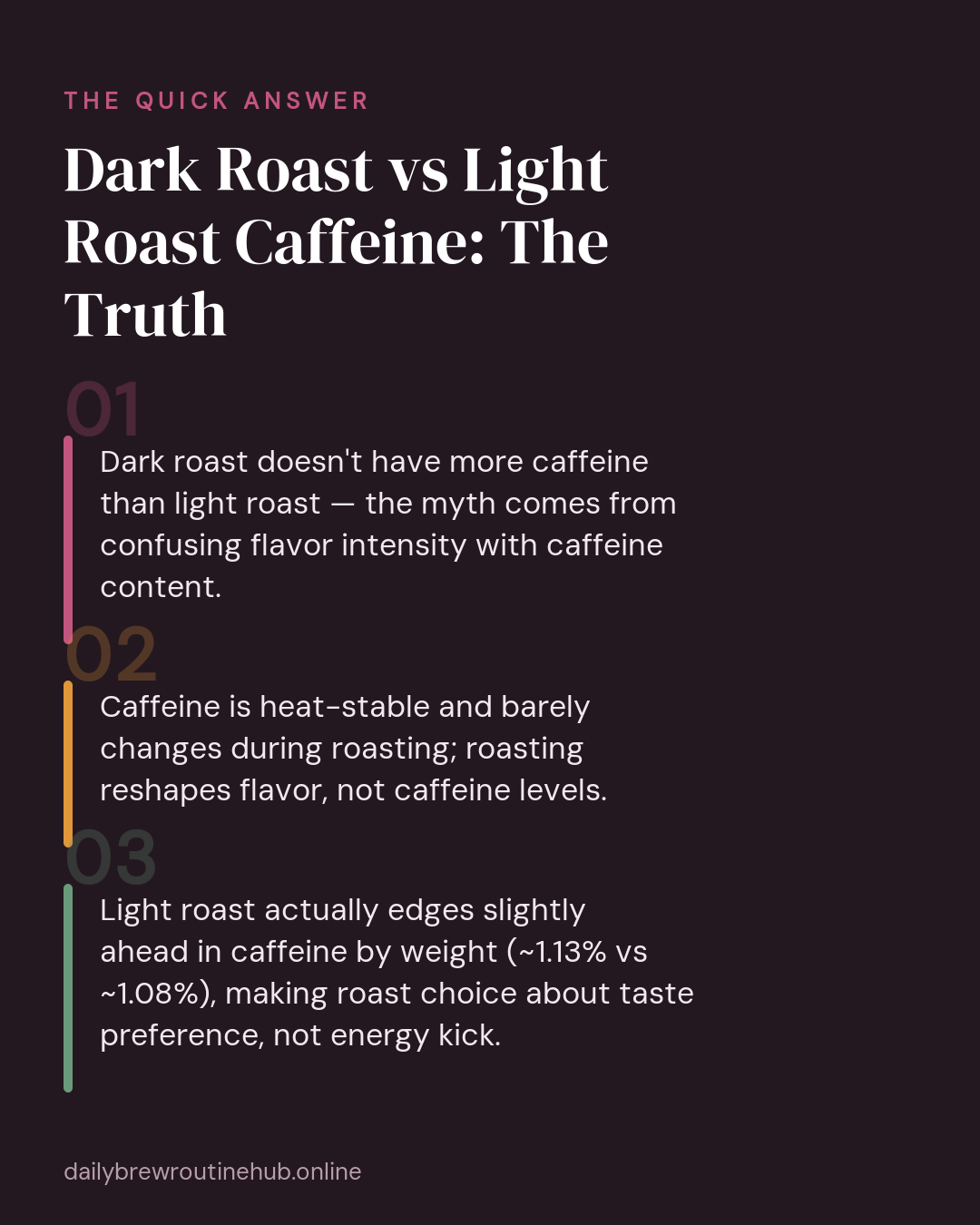
- Dark roast doesn't have more caffeine than light roast — the myth comes from confusing flavor intensity with caffeine content.
- Caffeine is heat-stable and barely changes during roasting; roasting reshapes flavor, not caffeine levels.
- Light roast actually edges slightly ahead in caffeine by weight (~1.13% vs ~1.08%), making roast choice about taste preference, not energy kick.
Does Dark Roast Coffee Really Have More Caffeine Than Light Roast? Debunking the Myth
If you’ve been reaching for the darkest roast on the shelf because you need the biggest caffeine kick — you’ve been working off a myth.
It’s one of the most persistent misconceptions in the coffee world. Dark roast tastes stronger, bolder, more intense. So it must pack more caffeine, right? Actually, the opposite is closer to the truth. And once you understand why, it changes how you think about your whole brewing routine.
The Caffeine Myth That Won’t Die
The “dark roast = more caffeine” belief makes intuitive sense on the surface. Dark roast is deeper in color, richer in flavor, sometimes even described as “more powerful.” Our brains naturally associate those qualities with potency.
But flavor intensity and caffeine content are two completely separate things. The robust, almost smoky taste of a dark roast comes from the roasting process itself — specifically, from the breakdown of sugars and organic acids under prolonged heat. Caffeine has almost nothing to do with it.
This matters more than you might think. If you’re choosing a roast level based on caffeine assumptions, you might be missing out on coffees you’d actually enjoy. And if you’re optimizing your home brew setup for a specific energy effect, roast level is the last variable you should be adjusting.
What Actually Happens Inside the Roaster
To understand why roast level barely moves the caffeine needle, it helps to know what roasting actually does to a coffee bean.
Green coffee beans are roasted at gradually increasing temperatures. Light roasts typically reach internal temperatures around 350–400°F, while dark roasts push closer to 420–450°F. As the bean heats up, several things change dramatically:
- Color deepens from pale green to light brown to deep mahogany or near-black
- Oils migrate to the surface of the bean (that glossy sheen on dark roast beans)
- Density decreases as moisture evaporates and cellular structure breaks down
- Flavor compounds transform — acids mellow, sugars caramelize, bitter compounds develop
What doesn’t change significantly? Caffeine.
Caffeine is remarkably heat-stable. It doesn’t meaningfully degrade until temperatures reach around 455°F (235°C) — and since most roasting processes peak below 470°F, caffeine content stays relatively static across all roast levels. The roasting chemistry actively reshapes flavor, body, and aroma. Caffeine remains largely unaffected.
The Real Caffeine Numbers Across Roast Levels
Here’s where the data gets interesting. When you measure caffeine content by weight, the differences between roast levels are surprisingly small:
- Light roast: ~1.13% caffeine by weight
- Medium roast: ~1.17% caffeine by weight
- Dark roast: ~1.08% caffeine by weight
Those are nearly identical. If anything, light roast edges slightly ahead, and dark roast comes in slightly behind — the reverse of what most people assume.
A 2024 peer-reviewed study published in Scientific Reports added more nuance: peak caffeine concentrations in brewed coffee were observed in roast batches with roughly 14–16% roasting losses (which corresponds to light to medium roast levels). Caffeine concentrations then decreased for darker roast batches — not dramatically, but consistently.
So where does the misconception come from? Mostly from how we measure.
When you scoop ground coffee by volume — like with a standard coffee scoop — dark roast beans are less dense than light roast beans. Roasting drives out moisture and causes the bean to expand and become more porous. By the time a bean reaches dark roast level, it weighs noticeably less than a lighter-roasted bean of the same physical size.
This means a heaped scoop of dark roast grounds contains less actual coffee by weight than the same scoop of light roast grounds. In one real-world test comparing identical volumes, light roast delivered around 60% more caffeine than dark roast — not because light roast has dramatically more caffeine per gram, but simply because you’re getting more grams of coffee per scoop.
The practical takeaway: If you measure coffee by weight (a kitchen scale is your friend here), light and dark roasts are nearly equivalent in caffeine. If you measure by volume with a scoop, light roast will likely give you more caffeine per cup.
Your Brewing Method Has Far More Influence Than Roast Level
Here’s the variable that actually moves the needle on caffeine: how you brew.
Extraction is the process of pulling soluble compounds — including caffeine — out of the coffee grounds and into your water. The more efficiently you extract, the more caffeine ends up in your cup. Extraction is driven by:
- Water temperature — hotter water extracts more efficiently
- Contact time — longer brew time means more extraction
- Grind size — finer grinds expose more surface area, boosting extraction
- Brew ratio — more coffee to water means a more concentrated cup
Consider these common brewing methods side by side:
Espresso forces near-boiling water through finely ground coffee under pressure in about 25–30 seconds. The resulting shot is small in volume but highly concentrated — roughly 60–65mg of caffeine per ounce. A standard double shot (2 oz) delivers around 120–130mg total.
French press uses a longer steep time (4–5 minutes) with coarser grounds and no paper filter. The extended contact and lack of filtration means more oils and caffeine compounds make it into the cup.
Pour-over sits in the middle — paper filters remove some oils, but water temperature and pour technique significantly affect extraction efficiency.
The key point: a light roast espresso and a dark roast French press will have very different caffeine levels — not because of the roast, but because of the extraction method. If you’re optimizing for caffeine, focus on your brewing variables, not your roast selection.
Light Roast vs. Dark Roast: What Actually Differs
If caffeine isn’t the meaningful difference, what should guide your roast choice? Flavor, body, and origin expression.
Light roast preserves more of the bean’s original character. You’ll often notice:
– Higher acidity and brightness
– Fruity, floral, or tea-like notes depending on the origin
– Complexity that shifts as the cup cools
– A lighter body overall
Dark roast transforms those origin characteristics through heat. Expect:
– Lower acidity, smoother on the palate for some drinkers
– Chocolate, caramel, toasted nut, or smoky notes
– A heavier, fuller body
– Consistent flavor that tends to mask origin-specific nuances
Neither is objectively better. Light roasts reward curiosity — they’re excellent for exploring how an Ethiopian natural process differs from a Colombian washed. Dark roasts reward consistency and comfort — that familiar, reliable boldness many home brewers grew up with.
Choose based on what you actually enjoy drinking, not on a caffeine assumption that doesn’t hold up to scrutiny.
Other Myths Worth Clearing Up
“Dark roast tastes stronger, so it must be stronger” — Strength in flavor and strength in caffeine are unrelated. The bitter, intense character of a dark roast is a product of caramelization and pyrolysis (the chemical breakdown of organic compounds under heat), not a sign of elevated caffeine.
The scoop myth — As covered above, measuring by volume systematically undercounts the caffeine in light roast relative to dark. If you’ve done a side-by-side and felt like dark roast hit harder, your scoop might have been partially responsible — you were likely using more grounds by weight when you scooped the denser light roast.
“Espresso has more caffeine than drip coffee“ — Per ounce, yes. Per typical serving, often no. A 12 oz drip coffee regularly contains more total caffeine than a double shot of espresso.
Grind size is the secret lever most home brewers ignore — Finer grinds extract more caffeine, everything else being equal. If you want to genuinely increase or decrease the caffeine in your cup, adjusting your grind size is more effective than swapping roast levels.
The Bottom Line: Choose Your Roast by Flavor
Here’s where we land: roast level has a negligible effect on caffeine content, and the tiny difference that does exist actually tilts slightly in favor of lighter roasts, not darker ones.
The myth persists because dark roast tastes more intense, and because volume-based measurement makes dark roast appear weaker when you’re actually just scooping less dense grounds. Neither of those factors is really about caffeine chemistry.
For home brewers, the actionable shift is this: stop trying to manage caffeine through roast selection and start paying attention to your brewing variables. Water temperature, grind size, brew time, and coffee-to-water ratio will do far more for the potency of your cup than anything printed on the roast label.
Pick your roast for the flavors it delivers. Then dial in your method for the extraction you want.
Want to get more out of your beans regardless of roast level? Check out our guides on [dialing in a pour-over brew], [getting consistent French press extraction], and [what espresso grind size actually means for your shot]. Small technique adjustments make a bigger difference than most home brewers expect.
Sources
- Java Myth Debunked: Light vs Dark Roast Coffee Caffeine Content | 7-Eleven
- Dark Roast vs Light Roast: Which Has More Caffeine? — 787 Coffee
- Light vs Medium vs Dark Roast: Which Has More Caffeine? | Peet’s Coffee
- Which Has More Caffeine: Light or Dark Roast? – Scribblers Coffee Co.
- Light Roast vs. Dark Roast: Which One Actually Has More Caffeine?
- Caffeine Levels in Coffee: Light Roast vs. Dark Roast – Blue Hummingbird Coffee