TL;DR
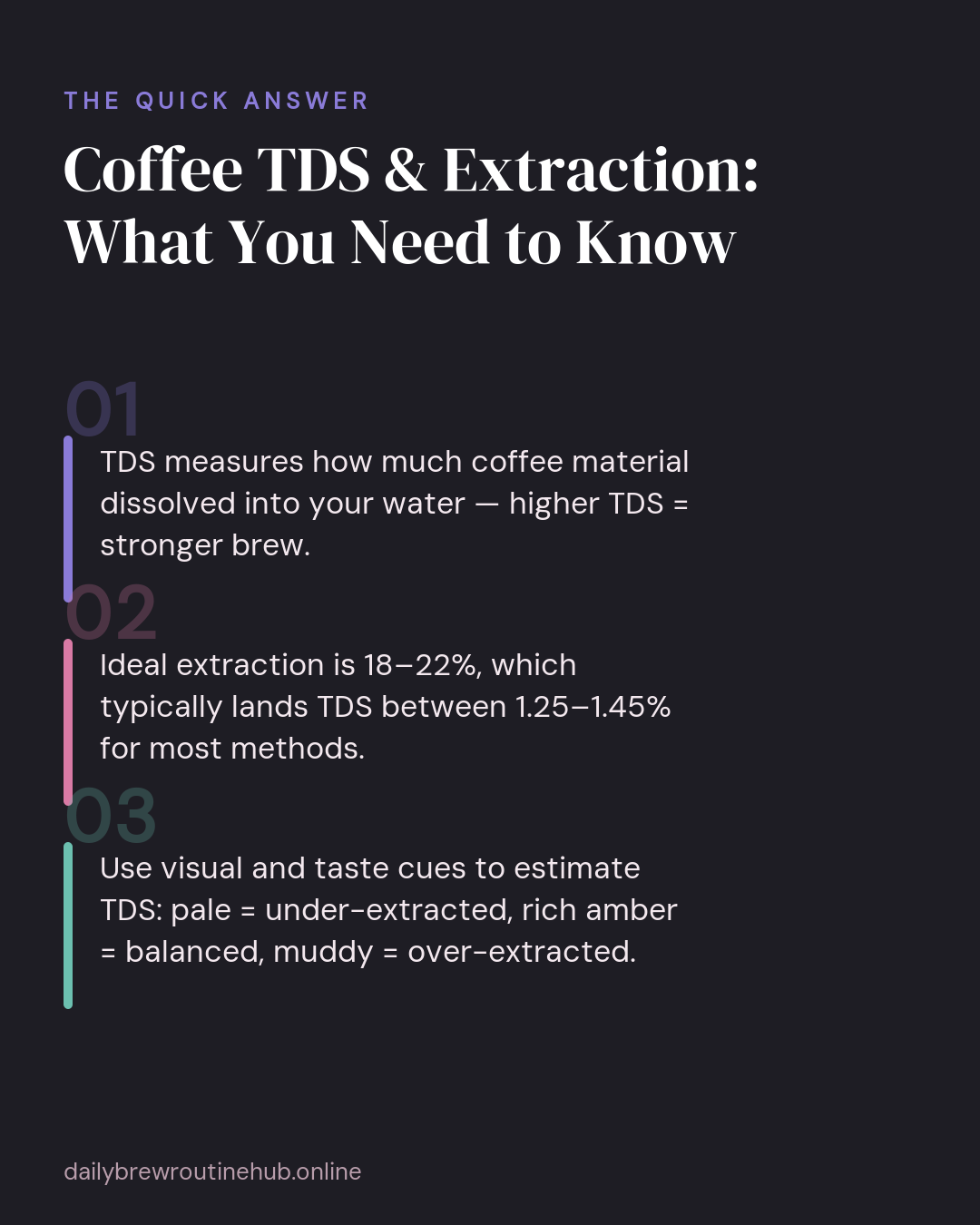
- TDS measures how much coffee material dissolved into your water — higher TDS = stronger brew.
- Ideal extraction is 18–22%, which typically lands TDS between 1.25–1.45% for most methods.
- Use visual and taste cues to estimate TDS: pale = under-extracted, rich amber = balanced, muddy = over-extracted.
Understanding Coffee’s TDS (Total Dissolved Solids) and Extraction: What It Means for Your Cup
If you’ve ever brewed a cup that tasted thin and sour, or so bitter it made you wince, TDS might be the explanation you’ve been missing.
TDS stands for total dissolved solids — it’s a measure of how much coffee material actually made it from your grounds into the water in your cup. Think of it as a score for how efficiently your brew pulled flavor out of the bean. Once you understand what TDS is telling you, you can troubleshoot almost any brew problem faster and with way more confidence.
Here’s what’s worth knowing: you don’t need a lab or expensive gear to start using TDS as a guide. Your eyes and your palate are already collecting the data. This post walks through the science, the targets by brew method, and practical fixes for the most common TDS problems home brewers run into.
The Science Behind TDS and Coffee Extraction
Extraction is the process of pulling soluble compounds from your coffee grounds into hot water. Those compounds include acids, sugars, oils, and aromatic molecules — the full spectrum of what makes coffee taste complex and satisfying.
TDS and extraction percentage are related, but they measure different things:
- Extraction percentage tells you what proportion of the coffee bean dissolved into the water. Most brewing methods hit their sweet spot somewhere between 18–22%.
- TDS is the absolute concentration of dissolved solids in your finished cup — essentially, how strong it is.
You can have a technically correct extraction percentage but still end up with a weak-tasting cup if you used too much water relative to your coffee dose. That’s why both numbers matter, and why brew ratio (coffee to water) sits at the center of most dialing-in conversations.
For most brewing methods, ideal extraction in the 18–22% range will typically land TDS between 1.25–1.45%. Espresso is a dramatic outlier — more on that below.
How to Measure TDS Without a Refractometer
Most home brewers don’t own a refractometer, and honestly, that’s fine — at least to start. You can build solid TDS intuition from visual and taste cues alone.
Visual cues:
– A very light, golden or pale color in the cup often signals under-extraction and low TDS.
– A rich, clear amber or dark brown is generally where you want to be.
– A muddy, opaque or almost syrupy appearance can indicate over-extraction, especially in methods like French press.
Taste cues:
– Weak, sour, or thin? Low TDS. Your brew didn’t pull enough from the grounds.
– Bitter, harsh, or drying? High TDS from over-extraction. Too much of the wrong compounds made it in.
– Bright, balanced, slightly sweet with a clean finish? You’re in the right range.
These cues aren’t perfect — they’re influenced by bean origin, roast level, and water chemistry too. But they’re genuinely useful as a starting point.
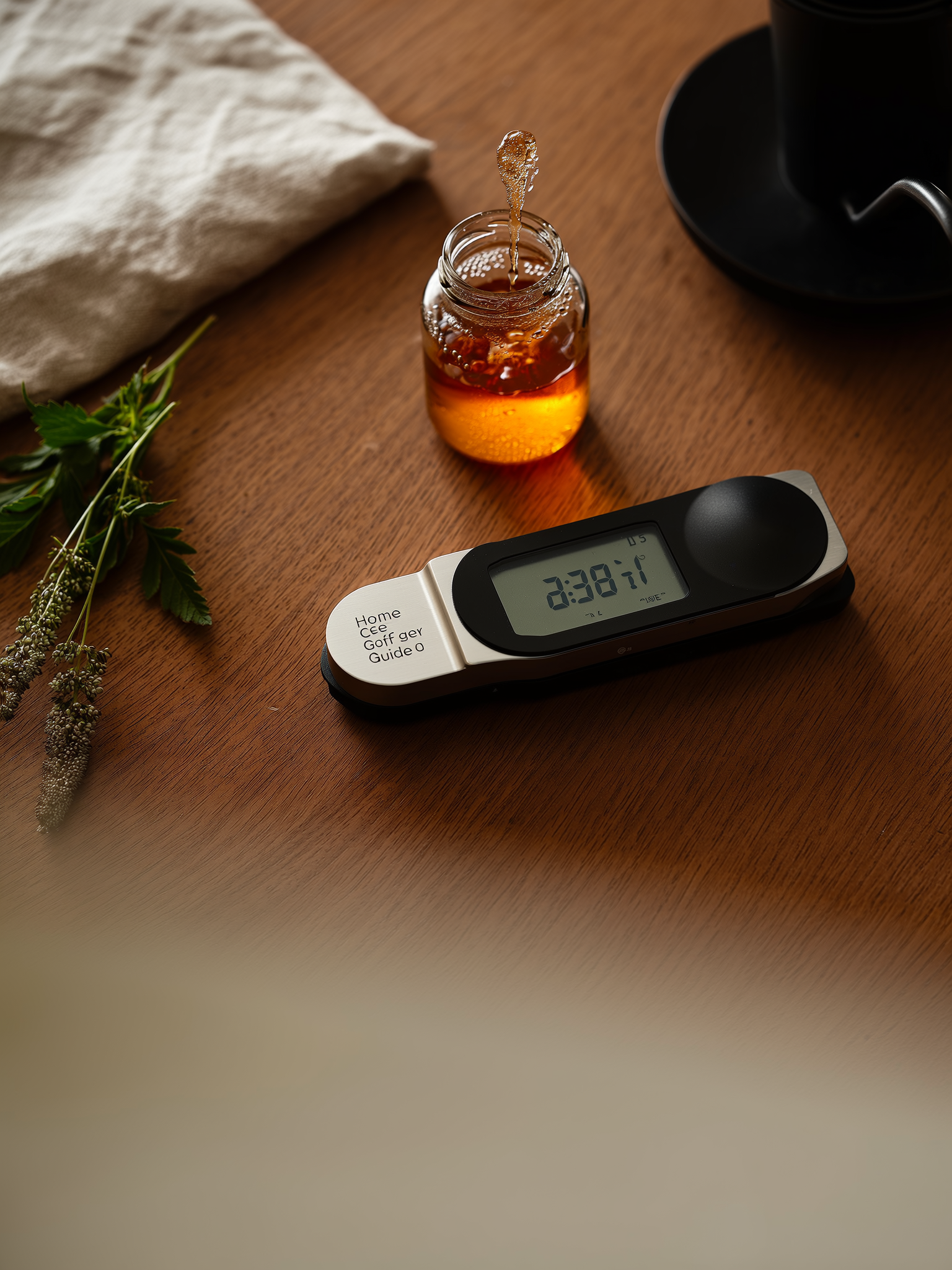
When you’re ready for numbers, a handheld refractometer is the tool for the job. A decent one costs around $30–$50 coffee refractometer handheld, takes about 30 seconds to use, and gives you a real TDS reading in percentage. Specialty brewers and competition-level baristas use them regularly for dialing in new beans. Once you start logging your TDS readings alongside your grind settings and brew ratios, you’ll learn your setup’s patterns surprisingly fast.
TDS Targets by Brewing Method
Different brewing methods extract at different intensities, so TDS targets aren’t one-size-fits-all.
Espresso
Espresso operates in a completely different league: target 8–10% TDS. The high pressure, short extraction time (around 25–30 seconds), and very fine grind all combine to produce a small, highly concentrated shot. That intensity is what makes espresso work as a base for milk drinks — it holds up against the dilution.
Pour-Over and Drip Coffee
For controlled, gravity-fed methods like pour-over or drip machines, you’re aiming for 1.25–1.45% TDS. This is the classic “specialty coffee” window. Consistent water temperature, grind size, and pour technique give you the most control over landing in this range repeatedly.
French Press
Immersion brewing means longer contact time between water and grounds, and coarser grinds to compensate. French press typically runs 1.5–1.75% TDS — a bit fuller and heavier in body than pour-over. If your French press tastes muddy or over-extracted, you may be going above this range.
Cold Brew
Here’s the counterintuitive one: despite steeping for 12–24 hours, cold brew tends to produce 1.0–1.25% TDS because cold water extracts much more slowly than hot water. The concentrate version is a different story — but for standard cold brew, expect a lower TDS with a smoother, less acidic character.
Adjusting Grind Size and Water Temperature to Control TDS
Once you understand your targets, you need to know which levers to pull. There are three main variables that drive TDS: grind size, water temperature, and brew time. They all interact, which is why changing multiple things at once makes it nearly impossible to figure out what actually changed your cup.
Grind Size
This is usually the most powerful variable.
- Finer grind → more surface area exposed → faster extraction → higher TDS
- Coarser grind → less surface area → slower extraction → lower TDS
This is why a grinder with consistent, adjustable settings is one of the highest-impact purchases for any home brewer. Inconsistent grind particle size (lots of fines mixed with large chunks) makes TDS management much harder because different-sized particles extract at different rates.
Water Temperature
- Hotter water (around 93–96°C / 199–205°F for most methods) extracts faster and tends to produce higher TDS
- Cooler water extracts more slowly and can produce a brighter, lighter cup — but push it too low and you’ll get under-extraction
For cold brew, you’re intentionally using the temperature lever to slow everything down, compensating with time.
Brew Time
Longer contact time means more extraction and higher TDS — up to a point. Past about 4–5 minutes in most immersion methods, even coarse grinds start pulling bitter, harsh compounds that you don’t want. This is why French press plunge timing matters, and why cold brew’s extreme steeping time works only because the cold temperature keeps extraction slow.
The key principle: adjust one variable at a time. If you change grind, temperature, and brew time simultaneously, you won’t know which one moved your TDS.
Common TDS Problems and How to Fix Them
Here are the most frequent issues home brewers face, and the simplest fix for each:
Problem: Weak, sour, or thin brew (low TDS)
Your extraction didn’t go far enough. The acids extracted early but the sweetness and body compounds didn’t follow.
Fix options — try one at a time:
– Grind finer
– Increase water temperature slightly
– Extend brew time (add 30–45 seconds per iteration and taste)
– Check your brew ratio — are you using enough coffee?
Problem: Bitter, harsh, or astringent cup (high TDS)
You’ve over-extracted. The bitter compounds that live deep in the cell structure of the bean made it into your cup.
Fix options — try one at a time:
– Grind coarser
– Lower water temperature by a few degrees
– Shorten brew time
– Make sure your grinder isn’t producing excessive fines (cheap blade grinders are notorious for this)
Problem: Inconsistent taste day-to-day
This is usually a consistency problem rather than a TDS problem specifically. Small changes — like grind retention in your grinder, water temperature drift, or even slightly different pour speed — compound across a brew.
Fix:
– Dial in one variable at a time and write it down
– Use the same coffee dose by weight, not volume (a kitchen scale makes a real difference here)
– If you’re using a kettle without temperature control, let it rest the same number of seconds after boiling each time
Building Your TDS Intuition Over Time
TDS is the bridge between coffee theory and what’s actually in your cup. It sounds technical, but at its core, it’s just a way of naming something your palate is already detecting every time you taste your brew.
The practical path for most home brewers looks something like this:
-
Start with taste cues. Sour and thin? Under-extracted, low TDS. Bitter and harsh? Over-extracted, high TDS. This feedback loop trains your palate faster than any reading.
-
Get a scale. Consistent brew ratios are the foundation of consistent TDS. Without measuring your coffee and water by weight, every brew is a slightly different experiment.
-
Lock in one variable at a time. When something’s off, change grind size first — it’s the most responsive lever. Then temperature. Then time.
-
Consider a refractometer once you want reproducible, logged numbers. It’s not necessary, but it turns troubleshooting from guessing into data.
Every bean you try, every new water source, and every seasonal roast change will shift your TDS slightly. That’s not a problem — it’s just part of the process. Your palate, calibrated over dozens of brews, becomes your most reliable instrument.
Understanding TDS won’t make your coffee perfect overnight. But it will make every imperfect cup a useful data point instead of just a frustration.
Curious about how grind size affects specific brew methods? Check out our guides on dialing in pour-over technique and French press brewing ratios for method-specific deep dives.