TL;DR
- Single-dose grinders retain less than 0.1g and eliminate stale grounds mixing into fresh doses.
- Hopper-fed grinders trade retention (0.5–3g) for speed and convenience, risking flavor inconsistency.
- Choose single-dose if you rotate bean origins; hopper-fed wins if daily speed matters more than perfection.
Single-Dose Grinders vs. Hopper-Fed Grinders: Solving the Retention and Static Clumping Problem
If your espresso tastes slightly off even when you’ve nailed your ratio and water temperature, the problem might be sitting inside your grinder right now — stale grounds from yesterday’s brew, quietly contaminating today’s shot. The single-dose vs. hopper-fed grinder debate really comes down to one core question: how much leftover coffee are you willing to tolerate, and what does it cost your cup?
Here’s the short answer: single-dose grinders minimize retention and staling at the cost of speed; hopper-fed grinders win on convenience but invite staleness and static clumping as built-in trade-offs. Which one belongs in your routine depends on how you actually brew — not on what gets the most hype on Reddit.
Let’s break it down.
What Retention Actually Means (and Why It Matters)
Retention is the ground coffee that stays trapped inside your grinder’s burrs, chute, and internal pathways after you’ve finished grinding. It doesn’t fall into your portafilter or brewing device. It just sits there, exposed to air, slowly going stale.
The next time you grind, those old grounds mix right in with your fresh dose.
The numbers are more varied than most people realize. Home conical burr grinders typically retain 0.2–1.5 grams, while flat burr models can hold 0.5–3 grams. Commercial grinders — designed for high throughput, not precision dosing — often retain 5–15 grams due to larger burr chambers and longer internal pathways.
For perspective: a standard espresso dose is 18–20 grams. If your grinder holds back 2–3 grams of old coffee and returns it to your next dose, you’ve just replaced 10–15% of your shot with yesterday’s grounds. That’s a real problem.
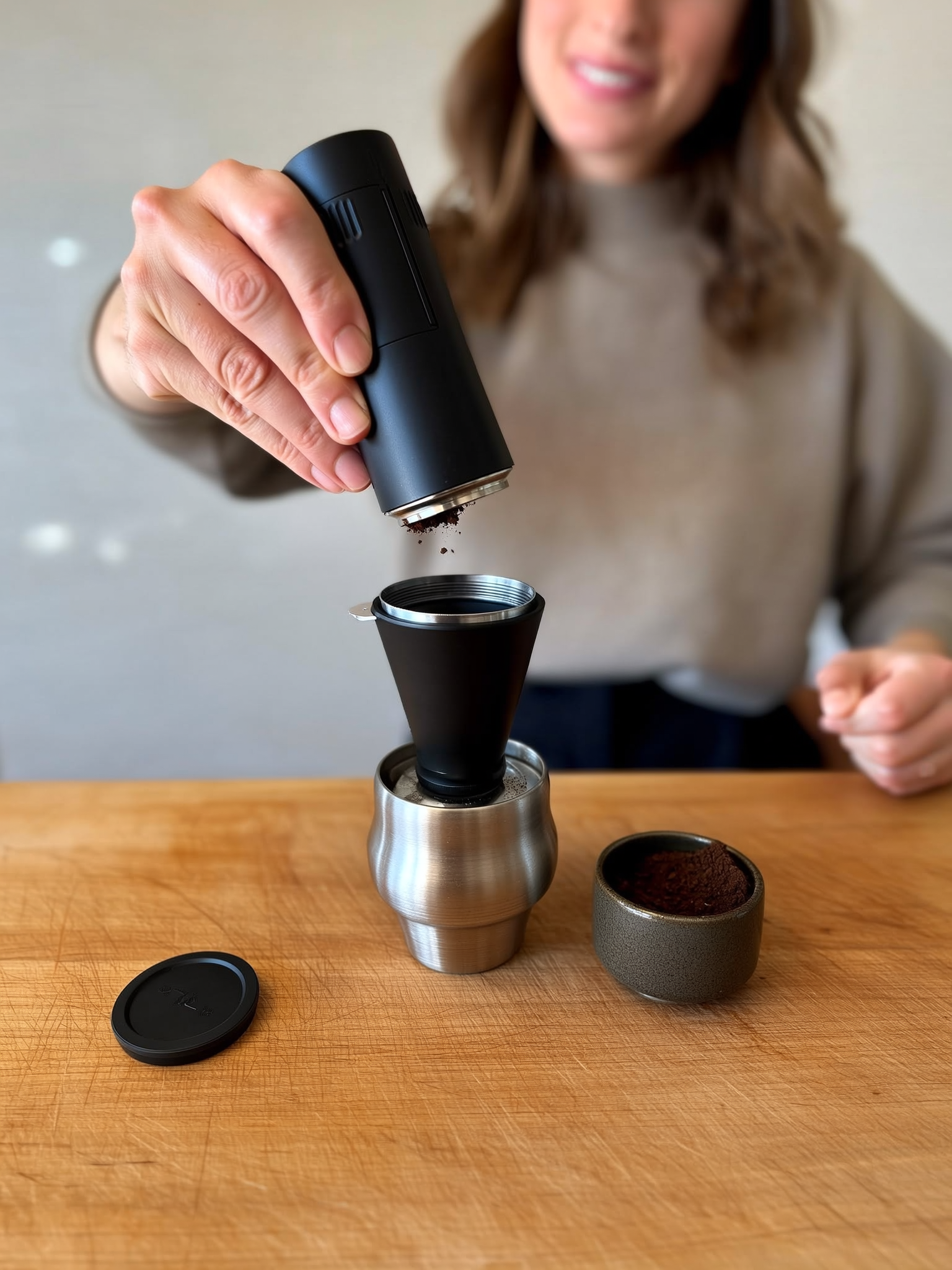
Single-dose grinders are built specifically to solve this. Many achieve less than 0.1 grams of retention, essentially clearing the chamber with each cycle.
Single-Dose Grinders: Built for Zero-Retention Brewing
The entire design philosophy behind a single-dose grinder is to use exactly what you load and leave nothing behind.
You weigh your beans — say, 18 grams — drop them directly into the grinding chamber, grind, and the output is nearly complete. No leftover grounds. No “purging” a stale puck to get to fresh coffee.
Design features that make this work:
- Anti-popcorning lids keep beans from bouncing unevenly at the top, ensuring consistent feed
- Bellows (built-in or aftermarket) push remaining fines out of the chute at the end of the grind cycle
- Tilted or angled bases use gravity to encourage complete discharge
Grinders like the Niche Zero Niche Zero Coffee Grinder and Fellow Ode Fellow Ode Brew Grinder have become popular in the home barista community precisely because they pair low retention with usable grind consistency.
Who single-dose suits best:
- Specialty coffee drinkers rotating between multiple origins or roast levels
- Espresso brewers who dial in by bean and want to avoid stale interference
- Anyone who grinds once or twice a day, not continuously through a busy morning
The trade-off is real: the workflow is slower. You’re loading, sometimes bellowing, and managing a small batch every single time. If you make four drinks a morning and you’re in a rush, that adds up.
Hopper-Fed Grinders: High Convenience, Real Trade-Offs
The hopper-fed approach is straightforward. You fill the hopper — sometimes with 200–500 grams of beans — and grind on demand. Quick, repeatable, and effortless for brewers who stick to a routine.
For households where everyone drinks the same coffee, same roast, every morning, this makes practical sense.
But the retention and staleness problems are built into the design.
As beans continuously feed through the grinder, grounds accumulate along the burr chamber and discharge chute. Unlike a single-dose grinder that clears between cycles, a hopper-fed grinder is never truly empty during normal use. Stale grounds from a previous session can sit there indefinitely, returning in small amounts to every subsequent dose.
There’s also the bean freshness issue in the hopper itself. A bean sitting exposed in an open hopper degrades faster than one sealed in its original bag. The hopper isn’t airtight — every time you grind, air cycles through, and oxygen reacts with coffee oils to accelerate staling. A bean loaded on Monday may taste noticeably different by Thursday.
Practical workarounds brewers use:
- Purging: Run a few grams of fresh beans through the grinder before pulling your actual shot to flush stale grounds — wasteful but effective
- Magnetic hoppers: Remove and store beans in the bag between uses, reducing exposure time
- Strict “use it fast” discipline: Only loading what you’ll use within a few days limits stale buildup
None of these fully eliminate the retention problem. They reduce it.
Static and Clumping: The Hidden Variable Most Guides Miss
Static electricity affects both grinder types — just in different ways — and it deserves more attention than it usually gets.
Here’s the physics: when metal burrs spin against coffee beans at high speed, the contact generates electrical discharge. This charge electrifies fine coffee particles, making them stick to chute walls, dosing cups, portafilters, and each other.
When grounds clump together, they form dense, impenetrable masses that resist hot water. Water finds the path of least resistance, shoots through weak spots in the puck, and leaves other areas under-extracted. Your shot pulls unevenly.
Where single-dose and hopper-fed grinders differ on static:
Here’s where conventional wisdom often misses the mark — single-dose grinders actually experience more static buildup per dose, not less. Without a mass of beans in the hopper to dampen the electrical charge, each small batch generates proportionally more static. Grounds stick to chutes aggressively, especially in dry climates or air-conditioned rooms.
Hopper-fed grinders benefit from the sheer mass of beans absorbing and grounding some of that charge. The problem isn’t absent, but it’s typically less severe per dose.
RDT and WDT: The Techniques That Actually Fix Static
The specialty coffee community has developed two main approaches to static and clumping, and both are worth knowing if you grind at home.
RDT — Ross Droplet Technique
This technique has a longer history than most people realize. In 2005, a user on an online coffee forum shared the idea of adding a few drops of water to beans before grinding, crediting someone named David Ross. The technique carries his name.
The practical guideline: 1–2 drops of water per 20 grams of beans. That’s enough moisture to reduce static charge without affecting grinder mechanics or changing extraction. It’s not flashy — it’s a small amount of water that introduces just enough conductivity to prevent the worst of the clinging.
RDT is especially valuable for single-dose users, but hopper-fed brewers in very dry conditions can benefit too.
WDT — Weiss Distribution Technique
This addresses the downstream problem after grinding: clumps already formed in the portafilter basket. A WDT tool is essentially a thin wire or needle used to stir and break up ground coffee before tamping, creating a uniform, channel-free bed.
Used together — RDT before grinding, WDT after — these techniques address static and clumping at both ends of the cycle. They’re low-cost additions (RDT costs nothing, a WDT tool is a few dollars) that meaningfully improve shot consistency.
Making the Decision: A Practical Framework
There’s no universal winner. The right grinder type comes down to your actual daily routine.
Choose single-dose if you:
– Rotate between different beans, origins, or roast levels frequently
– Pull one or two shots a day and have time for the workflow
– Prioritize shot-to-shot consistency and freshness above all else
– Enjoy the ritual of precision brewing
Choose hopper-fed if you:
– Drink the same coffee every day and buy in volume
– Make multiple drinks in quick succession each morning
– Value speed and simplicity over optimization
– Are earlier in your brewing journey and want less friction
On budget: Top single-dose grinders like the Niche Zero and Fellow Ode typically cost $200–$300. Hopper-fed options span a wider range — from basic $50 models to well-engineered flat burr machines at $300–$500+. The Eureka Mignon Specialita, a popular hopper-fed option Eureka Mignon Specialita, retains only 1.3 grams despite its design, showing that thoughtful engineering can close the gap on retention even in traditional hoppers.
Entry price doesn’t tell you much about retention performance. Research the specific model’s retention figures before buying — they vary widely even within the same category.
The Universal Grinder Principle
Whichever type you choose, one principle applies universally: learn your grinder’s specific behavior and work with it, not against it.
Every grinder has its own retention characteristics, static tendencies, and dial-in quirks. A single-dose grinder with high static in your kitchen can be tamed with consistent RDT. A hopper-fed grinder’s staleness risk can be dramatically reduced by removing the hopper between uses and sealing beans in their bag.
The brewers who get the best results aren’t the ones with the most expensive equipment. They’re the ones who understand what their gear does and have built a consistent routine around it.
Single-dose or hopper-fed, the path to a better cup runs through understanding — not just upgrading.
Looking to build out your grinder routine further? Check out our guides on dialing in espresso grind settings and choosing the right burr type for your brewing method.
Frequently Asked Questions
What is grinder retention and why does it matter for espresso?
Retention is ground coffee trapped in your grinder’s burrs and chute after grinding. If 2–3g of stale grounds mix into your next 18g dose, you’ve contaminated 10–15% of your shot with yesterday’s coffee, muddying flavor. Single-dose grinders solve this by retaining less than 0.1g per cycle.
Do single-dose grinders reduce static clumping?
Yes, partly. Because single-dose grinders are smaller and process less total volume, static buildup is lower than in large hopper models. However, static clumping depends more on burr material and bean moisture than on retention alone—both grinder types can experience clumping in dry conditions.
Is a single-dose grinder worth the extra time?
If you care about consistency and rotate between different bean origins, yes—fresh grinds prevent cross-contamination. If you brew the same bean daily and value speed over precision, a hopper-fed grinder’s convenience may outweigh the retention trade-off.
How much ground coffee does a typical hopper grinder retain?
Home conical burr grinders retain 0.2–1.5g, while flat burr models hold 0.5–3g depending on burr chamber size and chute design. Larger internal pathways mean more trapped fines and stale grounds.
Sources
- Single Dose Grinders Vs. Hopper Fed: What's Better for Home Espresso? | Seattle Coffee Gear
- Hopper vs. single dose grinders
- Single Dose Grinding vs. Hopper Grinding: Impact on Flavor and Grindin – Espresso Outlet LLC
- Single-Dose vs Hopper Grinding: Which Is Better for Home? – Podium Coffee Club
- What is single dosing in a coffee grinder? — Coffee Equipment Reviews
- Single Dose Grinding: Retention and Workflow Guide 2026