TL;DR
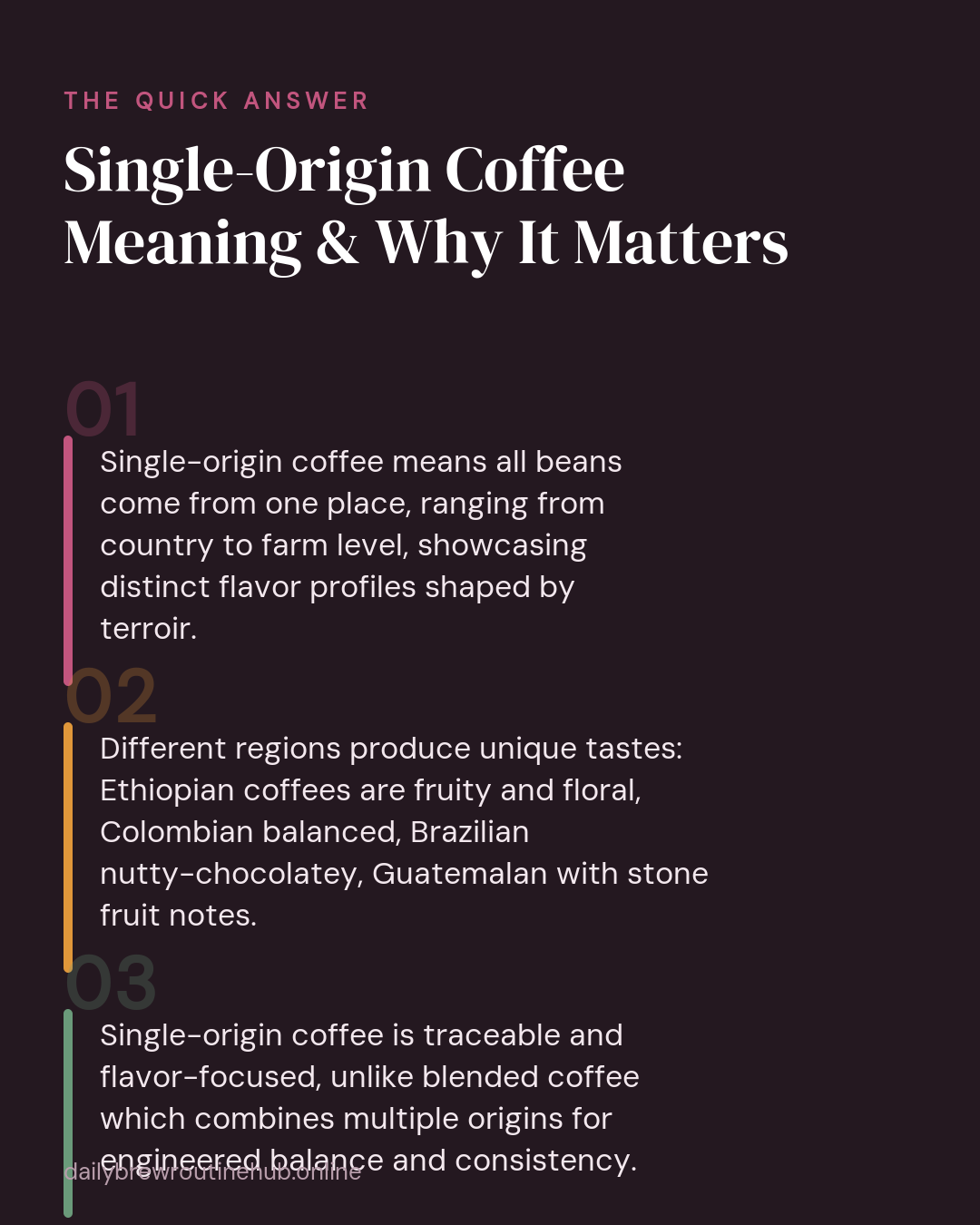
- Single-origin coffee means all beans come from one place, ranging from country to farm level, showcasing distinct flavor profiles shaped by terroir.
- Different regions produce unique tastes: Ethiopian coffees are fruity and floral, Colombian balanced, Brazilian nutty-chocolatey, Guatemalan with stone fruit notes.
- Single-origin coffee is traceable and flavor-focused, unlike blended coffee which combines multiple origins for engineered balance and consistency.
What Single-Origin Coffee Really Means (and Why It Matters)
If you’ve spent any time browsing a specialty coffee shop or scrolling through an online roaster’s catalog, you’ve almost certainly seen the words “single-origin” splashed across a bag. It sounds premium. It sounds intentional. But what does it actually mean — and does it make a real difference in your cup?
The short answer: yes, it does. But the longer answer is where things get interesting.
Understanding single-origin coffee isn’t just trivia. It shapes how you choose beans, how you dial in your brew method, and how much flavor you can coax out of your morning routine. Let’s break it down properly.
What Does Single-Origin Coffee Actually Mean?
At its most basic, single-origin coffee means all the beans in the bag come from one place. That “place” can vary in scale:
- Country-level: All beans from Ethiopia, Colombia, or Guatemala
- Region-level: Beans from the Yirgacheffe region of Ethiopia, or Huila department in Colombia
- Farm or estate-level: Beans from a single farm or cooperative, sometimes even a single lot on that farm
The more specific the origin, the more traceable — and often more distinct — the flavor profile tends to be.
This is fundamentally different from blended coffee, which intentionally combines beans from two or more origins. Blends aren’t inferior; they’re just built for a different purpose (more on that shortly). Single-origin coffee is about showcasing one specific place rather than engineering a balanced composite.
The concept behind single-origin coffee is deeply tied to terroir — a word borrowed from wine culture that describes how environmental factors like soil composition, altitude, rainfall, and temperature shape the final product. A coffee bean grown at 2,000 meters in the Ethiopian highlands and one grown at 900 meters in Brazil will taste nothing alike, even if they’re roasted identically. That’s terroir at work.
How Origin Shapes Flavor (And Why It Matters for Brewing)
This is where single-origin gets genuinely exciting for home brewers.
Different growing regions produce distinctly different flavor profiles, and once you taste them side by side, the differences are impossible to miss:
- Ethiopian coffees are famous for bright, fruity, and floral notes — think blueberry, jasmine, bergamot. Yirgacheffe in particular is beloved for its almost tea-like delicacy.
- Colombian coffees tend to offer a more balanced cup: medium acidity, red fruit or caramel sweetness, smooth body. A great entry point for beginners.
- Brazilian coffees lean toward low acidity, with nutty, chocolatey, and sometimes slightly earthy notes. Their consistency makes them popular for espresso blends.
- Guatemalan coffees often show brown sugar and stone fruit characteristics, with a heavier body than many East African options.
These aren’t just marketing descriptors — they reflect real chemical differences in the bean driven by altitude, soil, and processing method.
Roast level matters too. A light roast on an Ethiopian natural-process bean will taste wildly different from a dark roast of the same coffee. Light roasting preserves the origin-specific compounds that create those fruity, acidic, complex notes. The darker you roast, the more those unique characteristics get overshadowed by roast flavors — char, bitterness, smokiness. This is why most specialty roasters source exceptional single-origin beans at light to medium roasts. They want you to taste the place, not just the roast.
Processing method adds another layer. Even within the same farm, a washed (wet-processed) coffee will taste cleaner and more acidic than a natural (dry-processed) coffee from the same lot. Natural processing leaves the fruit pulp on the bean during drying, which adds sweetness and fermented fruit complexity. Washed coffees let the origin’s inherent flavors come through more clearly without the “noise” of fermentation. As a home brewer, knowing whether your single-origin is washed or natural helps you predict what flavor direction you’re headed in.
Single-Origin vs. Blended Coffee: When Each Wins
Neither single-origin nor blended coffee is objectively better. They’re tools for different goals.
Single-origin coffee wins when:
– You want to explore and taste what a specific region or farm produces
– You’re brewing with methods that highlight nuance — pour-over, AeroPress, siphon, or filter drip
– You’re building a palate and developing a vocabulary for coffee flavors
– You enjoy variation from bag to bag (since harvests change year to year)
Blended coffee wins when:
– You need consistency — the same cup every morning, regardless of which harvest year’s beans are in the bag
– You’re pulling espresso shots, where the high pressure and heat of an espresso machine can amplify sourness or imbalance in some single-origin beans
– You want a lower price point without sacrificing a reliably enjoyable cup
– You’re serving a mixed household where not everyone wants to think about flavor notes
Many experienced home brewers keep both on hand. Single-origin bags are for weekend pour-over sessions when you have time to pay attention. The trusty blend goes into the grinder for quick weekday mornings when you just need coffee, not a tasting experience.
I personally treat single-origin bags as my “learning coffee” — each new one teaches me something about what altitude, process, or region does to a cup. The blend is there when I’m half-awake and not in exploration mode.
Why Specialty Roasters Make Such a Big Deal of Single-Origin
The premium price tag on single-origin coffee isn’t arbitrary. There’s real cost and effort behind it.
Traceability requires relationships. For a roaster to tell you that a coffee comes from a specific farm at 1,800 meters in Sidama, Ethiopia, they need a direct or near-direct relationship with the producer. That means more communication, more logistics, and often paying above commodity market prices to maintain that relationship.
Quality control is more demanding. With a blend, a roaster can adjust the recipe if one origin has a weaker harvest. With single-origin, the roaster has to stand behind that one coffee as-is. That puts more pressure on sourcing carefully.
It supports transparency in the supply chain. When you can trace a coffee back to a specific farm or cooperative, you get a clearer picture of where your money goes. Many specialty roasters who focus on single-origin also emphasize direct trade or ethical sourcing practices — paying farmers fairly and investing in the communities that grow the coffee. Buying single-origin is one way to vote with your wallet for a more transparent coffee industry.
This doesn’t mean blended coffee is unethical — that’s an oversimplification. But single-origin coffee does make traceability easier to verify.
How to Actually Taste Single-Origin Coffee at Its Best
Buying a beautiful single-origin bean and then brewing it sloppily defeats the purpose. Here’s how to give it a fair shot:
Grind fresh. Pre-ground coffee loses aroma compounds quickly. If you’re serious about tasting what a single-origin has to offer, grinding just before brewing makes a real difference. A burr grinder burr coffee grinder gives you consistent particle size, which matters for even extraction.
Use clean, filtered water. Water quality affects taste more than most people expect. Hard, heavily chlorinated water can flatten the delicate notes that make single-origin interesting.
Dial in your brew ratio. A starting point of 1:15 to 1:17 (coffee to water by weight) works well for most filter brewing methods. Use a scale rather than scoops — inconsistent ratios make it impossible to isolate what the bean actually tastes like.
Choose the right brew method. Pour-over methods like the Hario V60 Hario V60 pour-over dripper or Chemex let you control every variable and highlight clarity and brightness. AeroPress gives you flexibility to experiment with pressure and steep time. French press adds body and richness, which can work well with naturally processed beans. Espresso is trickier — some single-origins pull beautifully as espresso, but many are dialed in better as filter coffee.
Keep loose tasting notes. You don’t need to be a professional Q-grader. Just jot down what you notice: fruity, sweet, acidic, earthy, chocolatey, floral. Over time, you’ll start to recognize patterns — Ethiopian naturals reliably give you that fruit-forward profile; Colombian washed coffees will feel more balanced and clean. Building this mental map makes every future bag more interesting.
A final tip: buy small quantities of single-origin to start. Specialty roasters often sell 250g bags that let you try a lot without committing to a kilogram of something you might not connect with.
Single-Origin Coffee Is a Gateway, Not a Destination
Learning what single-origin coffee means — and actually tasting it — is one of the fastest ways to deepen your understanding of home brewing.
It reframes coffee from a commodity into something with geography, history, and craft behind it. Once you’ve tasted the blueberry brightness of a Yirgacheffe pour-over alongside the cocoa-smooth comfort of a Brazilian blend, you can never fully un-know that difference.
Start simple: pick one origin you’re genuinely curious about, keep your brew method consistent, and pay attention to what lands in the cup. Then try a different origin with the same method, and notice what changes.
Better yet, use single-origin exploration as a reason to dial in your home gear. A quality burr grinder, a reliable scale, and a good brewer aren’t just purchases — they’re instruments that make the flavors in well-sourced beans audible. The beans do the talking; your setup just needs to stay out of the way.
That’s the real reason single-origin coffee matters for home brewers: it gives you something worth listening to.
Photo by Fatih Mehmet YILDIZ on Unsplash