TL;DR
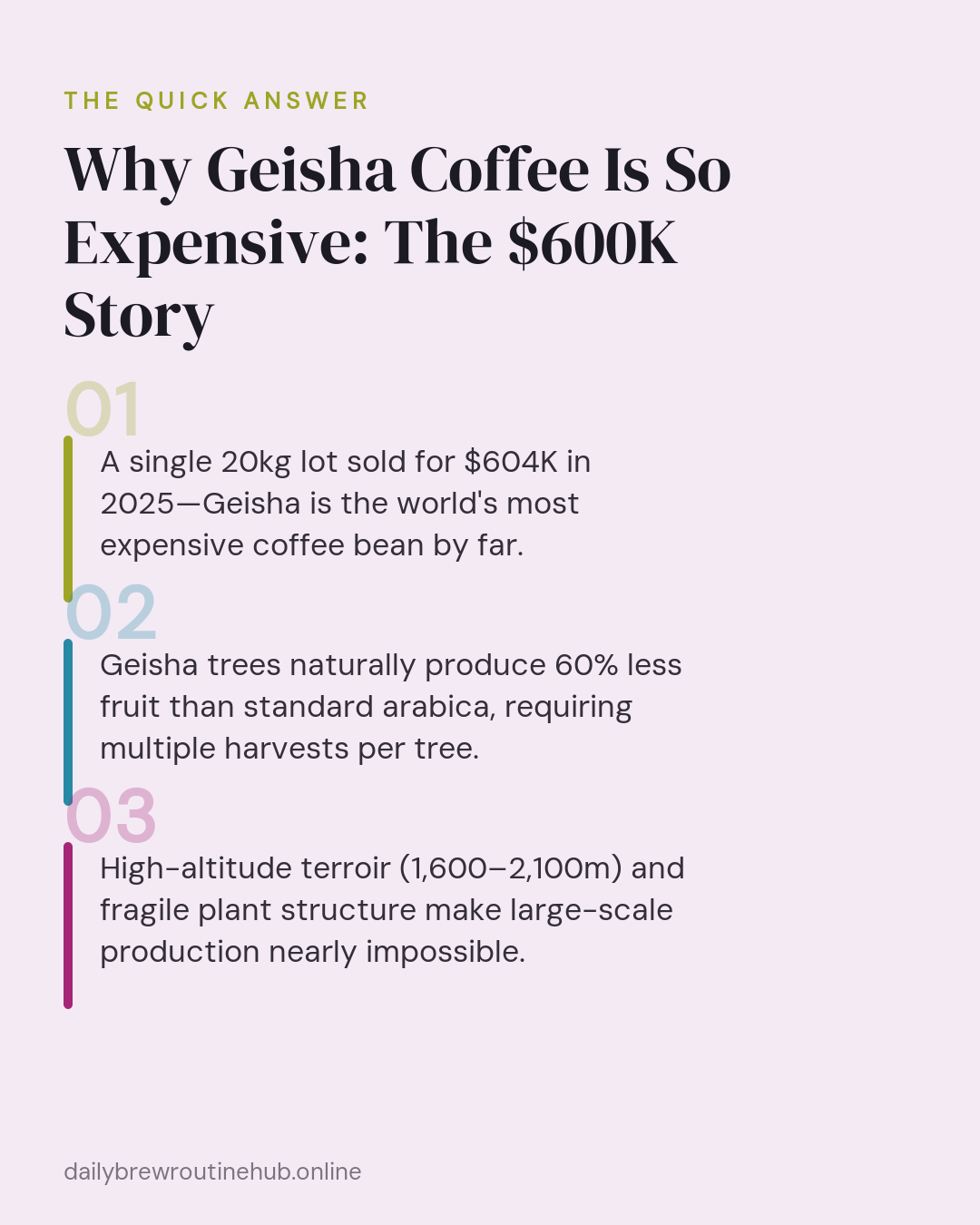
- A single 20kg lot sold for $604K in 2025—Geisha is the world's most expensive coffee bean by far.
- Geisha trees naturally produce 60% less fruit than standard arabica, requiring multiple harvests per tree.
- High-altitude terroir (1,600–2,100m) and fragile plant structure make large-scale production nearly impossible.
Why Is Geisha (Gesha) Coffee So Expensive? – Complete Guide to the World’s Rarest Coffee Bean
A 20-kilogram lot of coffee sold for $604,080 at the 2025 Best of Panama auction. That’s not a typo — and no, it wasn’t bought by a billionaire who lost a bet.
That single sale tells you everything about why Geisha (also spelled Gesha) coffee exists in a completely different universe from your grocery-store bag of arabica. But record auction prices aren’t the whole story. Understanding why this coffee commands such staggering sums — from the biology of the plant itself to the mechanics of specialty coffee culture — is genuinely fascinating. And it’s a story that starts not in Panama, but in a forest in southwestern Ethiopia.
What Is Geisha Coffee? Origin and History
The name comes from a place, not a cultural reference. Gesha (the spelling preferred by many origin producers) refers to the town of Gesha in southwestern Ethiopia, where the varietal was originally collected in the 1930s. It’s part of Ethiopia’s extraordinary heirloom coffee diversity — a region where wild coffee plants have been evolving for thousands of years.
For decades, Gesha was largely overlooked. It made its way to Central America in the 1960s and 70s, where it was planted in Panama, among other places, primarily as a disease-resistant option rather than a cup-quality standout.
Then came 2004.
That year, Hacienda La Esmeralda entered a lot of Geisha into the Best of Panama blind-tasting competition. The judges — specialty coffee professionals who never see a label during evaluation — gave it an unprecedented score. The coffee sold for $21 per pound, a world record at the time. Within a few years, Geisha had become the most talked-about coffee on the planet.
Why Geisha Plants Produce So Little Fruit
Here’s where the economics start to make sense. Geisha isn’t expensive purely because of hype. The plant itself is genuinely difficult to grow profitably.
A few key agricultural realities:
- Low yield by nature. Gesha trees produce significantly less cherry per plant than standard arabica cultivars like Bourbon or Typica. Fewer cherries per tree means more land and more plants needed to fill even a modest lot.
- High-altitude dependency. To express its signature floral aromatics, Gesha needs to grow at 1,600 to 2,100+ meters elevation. That land is scarce, hard to access, and expensive to farm.
- Structural vulnerability. The trees are tall and their branches are relatively fragile — they can actually break under the weight of ripening cherries, which growers have to manage actively.
- Uneven ripening. Cherries don’t all ripen at the same time on the same tree. A picker may walk the same tree five or six times in a single season, returning repeatedly to harvest only the cherries at peak ripeness.
- Disease susceptibility. The tall, dense foliage creates humid pockets where leaf rust and other fungal diseases thrive. Keeping plants healthy enough to produce quality fruit takes consistent, attentive care.
Every one of these factors adds cost before a single bean is processed.
The Rarity Factor: Limited Supply and Micro-Lot Farming
Even setting aside the plant’s agricultural challenges, Geisha supply is constrained at a structural level.
While the varietal originated in Ethiopia and has been planted in Colombia, Costa Rica, and other countries, it has most consistently expressed its full cup quality in Panama’s Boquete highlands. Attempts to replicate the exact flavor profile elsewhere have often fallen short — suggesting that specific soil composition, altitude, and microclimate all interact in ways that are hard to duplicate.
The most celebrated Geishas come from single estates or specific hillsides — true micro-lots measured in dozens or hundreds of kilograms, not tonnes. Hacienda La Esmeralda, for example, sources from distinct sections of their farm, each with slightly different elevation and sun exposure.
Global annual production of top-tier Geisha is measured in hundreds of bags, not thousands. For context, a commodity-grade coffee origin might produce millions of bags per year. This is a fundamentally different supply situation.
Only well-resourced estates can absorb the financial risk of growing Geisha. The combination of low yield, high labor, and the real possibility of crop loss to disease or weather makes it impractical for smaller growers to gamble on.
The Flavor Profile That Justifies the Premium
Here’s something worth emphasizing: Geisha’s price isn’t purely auction theater. It earns its scores in blind tastings.
The flavor profile is genuinely unlike most other coffees:
- Jasmine and bergamot florals — often the most immediately striking characteristic
- Mango, papaya, and tropical fruit notes — a brightness that reads almost juicy
- Silky, tea-like body — lighter and more delicate than a typical espresso-forward bean
- Peach and stone fruit — especially pronounced in naturally processed lots
Specialty-grade Geishas regularly score 85–92+ on the SCA scale, and the record lot at the 2025 Best of Panama auction scored an extraordinary 98.00 points.
The reason those scores carry real credibility: the tasting is blind. Judges evaluate the cup without knowing the origin, producer, or price. That means the quality is verified independently, not simply marketed.
For home brewers, Geisha is often best appreciated through methods that highlight clarity and aromatics — a pour-over or Chemex tends to let the floral and fruit notes shine more clearly than a heavy espresso extraction would.
Auction Culture, Demand, and the Prestige Premium
Even genuine quality doesn’t fully explain a $30,000-per-kilogram price tag. Part of what you’re paying for — especially at the top of the market — is scarcity combined with competitive demand.
The Best of Panama competition has become the defining annual event in Geisha pricing. Roasters from Japan, South Korea, the US, and beyond compete aggressively to secure micro-lots. Being able to say you sourced that year’s top-scoring Geisha is itself a marketing asset.
Third-wave coffee culture has also elevated Geisha into something approaching a status symbol. Its exotic origin story, documented auction history, and sheer inaccessibility have made it aspirational — which feeds willingness to pay at every level of the market, not just at auction.
What does this mean for retail pricing?
The math compounds quickly:
- Farm-gate prices for exceptional lots: $30–80+ per pound
- Add international shipping, import duties, and customs clearance
- Add the roaster’s margin and storefront costs
- Consumer-accessible Geisha from reputable specialty roasters typically lands at $60–105+ per pound (Gesha Village Gesha, for instance, runs around $105/lb in many markets)
That said, most consumers will never interact with auction-price Geisha. The $604,080 lot is a benchmark signal for the market — it’s not what’s sitting on your local roaster’s shelf.
How to Identify Authentic Geisha and Avoid Mislabeled Coffee
The premium price has, predictably, attracted some less-than-honest labeling. Here’s what to look for before spending serious money.
Signs of a legitimate Geisha:
- Full traceability — estate name, harvest year, altitude, and processing method should be clearly listed
- Cupping score listed or available — reputable roasters publish their SCA scores or can provide them on request
- Specific origin details — “Geisha from Panama” is a start; “Geisha from Hacienda La Esmeralda, Boquete, washed process, 1,650m, 2024 harvest” is what you want
Red flags:
- “Geisha-style” with no origin details
- Vague claims like “Ethiopian heirloom blend with Geisha characteristics”
- Price that seems too good to be true — a genuine, single-origin Geisha under $15 per ounce at retail is almost certainly mislabeled or blended significantly
There’s nothing wrong with lower-cost Geisha-adjacent coffees. Some smaller Panama farms produce solid Geisha lots that don’t command top-tier auction prices but still offer a genuine taste of the varietal. Transparency is the key indicator of authenticity.
So, Is Geisha Coffee Worth It?
That depends on what you’re buying it for.
For the sensory experience: If you’ve never tasted a clearly floral, fruit-forward coffee with a tea-like clarity, a cup of well-sourced Geisha is a genuine revelation. It tastes completely different — and that difference is real, not imagined. Brewing it as a pour-over at home and tasting it side-by-side against a standard washed Ethiopian is one of the more eye-opening experiments in home coffee.
As an everyday coffee: Probably not. The economics don’t work unless you have an unusually large gear and coffee budget, and Geisha’s delicacy can feel wasted on a rushed morning routine.
As a curiosity and learning experience: Absolutely worth trying at least once. Even a small bag (many specialty roasters sell 50g or 100g samples) gives you a reference point for what exceptional cup quality actually means — and that context improves how you evaluate everything else you drink.
The price of Geisha is high for compounding, legitimate reasons: a fragile plant that produces little fruit, grown on scarce high-altitude land, harvested by hand across multiple passes, sourced in tiny quantities, and genuinely verified by blind tasters to be extraordinary. That’s not branding. That’s just a very difficult coffee to grow and a very easy one to fall in love with.
Interested in exploring what makes high-altitude coffees taste so different? Check out our deep dive into [washed vs. natural processing methods], or if you’re ready to brew Geisha at home, our [beginner pour-over brewing guide] covers exactly how to get the most from a delicate single-origin bean.
Sources
- Why Is Geisha Coffee So Expensive? Is It Worth It? Inside This Gourmet Bean — Corner Coffee Store
- Why is Geisha Coffee So Expensive? – Hayman Coffee
- What It Means When Your Coffee Beans Are ‘Geisha’ (And Why They’re So Expensive) – Chowhound
- What Is Gesha (Geisha) Coffee and Why Does It Cost So Much? | CBD Coffee Journal | Buddha Beans Coffee Co.
- Unveiling the Luxury of Geisha Coffee: Why This Exotic Brew Comes with a Hefty Price Tag – CoffeePlusThree
- What Is Geisha Coffee? Why It’s So Rare & Expensive – Spirit Origin Coffee