TL;DR
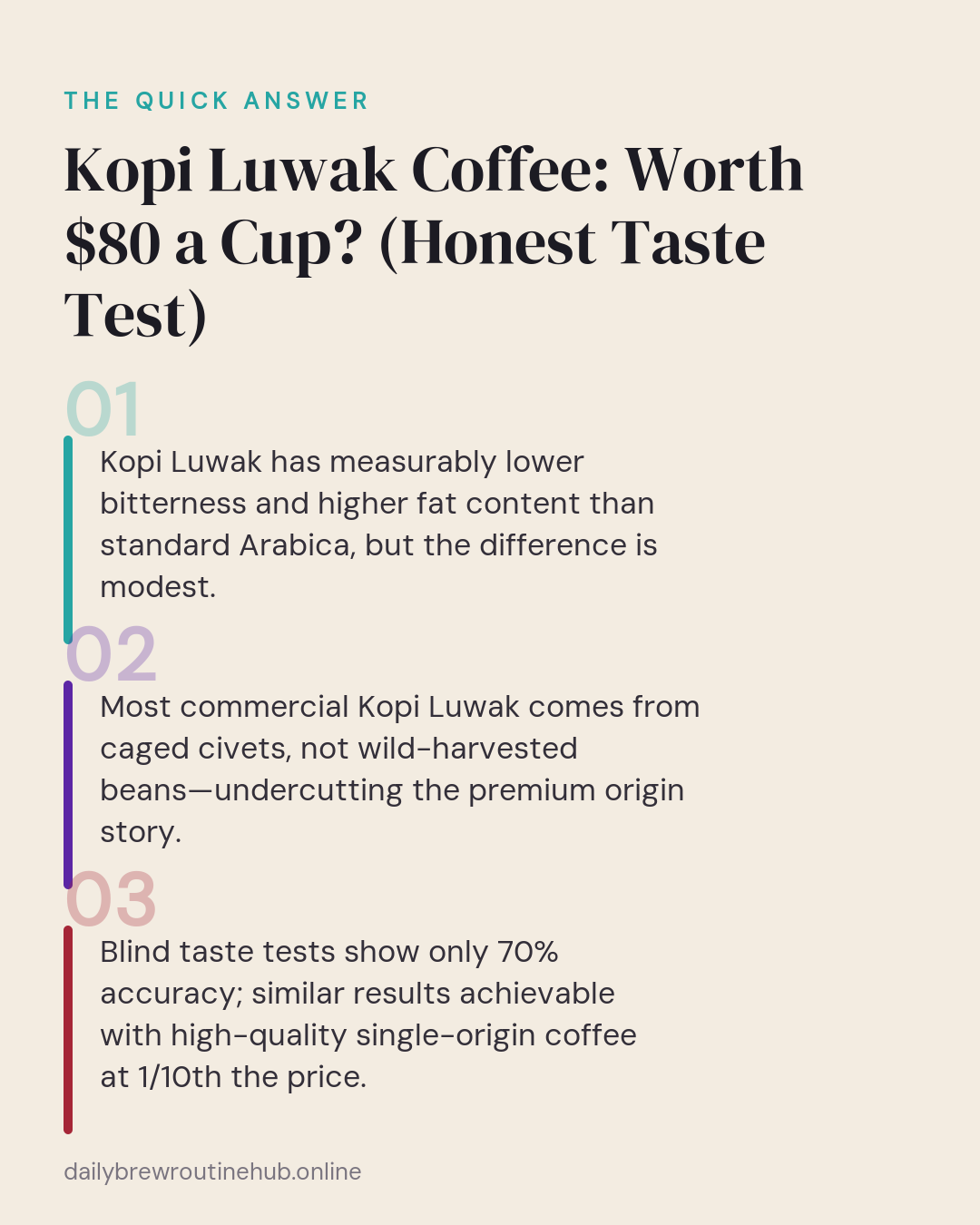
- Kopi Luwak has measurably lower bitterness and higher fat content than standard Arabica, but the difference is modest.
- Most commercial Kopi Luwak comes from caged civets, not wild-harvested beans—undercutting the premium origin story.
- Blind taste tests show only 70% accuracy; similar results achievable with high-quality single-origin coffee at 1/10th the price.
Kopi Luwak (Civet Coffee): Is It Actually Worth the Sky-High Price?
You can pay up to $80 for a single cup of coffee — and the selling point is that a wild cat already digested it. That’s the Kopi Luwak pitch, and somehow, it works.
Whether you’ve seen it on a café menu or stumbled across $500-per-pound listings online, civet coffee has a way of making people ask the same question: is any coffee actually worth that? Let’s break down what’s really in the cup — the flavor chemistry, the fraud problem, the animal welfare crisis — and whether the price tag holds up to scrutiny.
What Is Kopi Luwak? The Origin Story
Kopi Luwak originates from Indonesia — primarily Sumatra, Java, and Sulawesi — where Asian palm civets (small cat-like mammals) roam coffee plantations and naturally consume ripe coffee cherries.
The civets digest the outer fruit pulp, but the coffee beans pass through their digestive system largely intact. During digestion, enzymes alter the beans’ chemical composition. After collection from droppings, the beans are cleaned, dried, and roasted.
That’s the traditional story — and it’s genuinely interesting.
Here’s where it gets complicated: The “wild civet” narrative that commands $600–$1,300 per pound is increasingly disconnected from how most commercial Kopi Luwak is actually produced today. More on that shortly.
What Does Civet Coffee Actually Taste Like?
The flavor reputation of Kopi Luwak centers on a few consistent descriptors: earthy, smooth, low-acid, with hints of chocolate and caramel. Fans often describe it as unusually gentle on the stomach and less bitter than a comparable dark roast.
Is there science behind this? Yes — and it’s more nuanced than marketing copy suggests.
Research shows measurable chemical differences in civet coffee compared to standard Arabica:
- Lower bitterness: Civet coffee has significantly reduced chlorogenic acid (CGA) — measuring around 5.09 grams per 100g, compared to 7–12 grams per 100g in typical Arabica. CGA breaks down into bitter-tasting compounds during roasting, so lower CGA means less bitterness.
- Higher fat content: Civet coffee contains roughly 40% more fat, plus two compounds associated with dairy-like aroma — which likely contributes to its reported smoothness and body.
- Identical baseline compounds: Caffeine, protein, acidity, sugar levels, and pH all test the same as regular coffee beans.
In blind taste tests, tasters identified Kopi Luwak correctly about 70% of the time — specifically based on its lower bitterness and smoother texture rather than any dramatic difference in flavor complexity.
The honest takeaway: the difference is real, but modest. The gap over a high-quality single-origin Arabica from the same region is mostly texture and bitterness, not a transformative tasting experience. And one important caveat — most published taste tests used commercially available civet coffee, which as we’ll cover below, usually means cage-farmed product, not genuinely wild-sourced beans.
The Price Tag: What Are You Actually Paying For?
Kopi Luwak retails anywhere from $45 to $1,300 per pound, with individual cups running as high as $80 in specialty cafés.
That’s an enormous range, and understanding why requires separating the genuine cost drivers from the marketing machine.
Legitimate cost factors:
– Wild civets produce small quantities naturally — genuine wild-collected beans are rare and labor-intensive to source
– Processing and quality control on authenticated beans requires care
– Import and certification adds cost at every step
The marketing layer on top:
– Novelty and exclusivity branding inflate perceived value far beyond production cost
– “World’s most expensive coffee” is itself a marketing claim that perpetuates the premium
– Supply chain markups are steep — farm-gate prices for verified wild beans are a fraction of retail cost
Here’s the fraud problem that rarely gets front-page attention: up to 80% of Kopi Luwak labeled as wild-sourced actually comes from caged civets, according to PETA investigations. Beyond that, standard coffee is sometimes sold as Kopi Luwak entirely, or genuine civet beans are diluted with cheaper varieties.
Authenticity verification is genuinely difficult. Most retailers — even well-meaning ones — cannot trace their supply chain with confidence. The practical result: you may be paying $300 per pound for a product that is neither ethically sourced nor particularly special.
The Animal Welfare Crisis Behind the Cup
This section matters — both ethically and for coffee quality.
The romantic image of wild civets wandering through moonlit coffee plantations does not reflect the dominant commercial reality. Most Kopi Luwak on the global market comes from civets kept in captivity, and investigations into commercial farms have documented severe conditions: animals confined in small wire cages, sick with open wounds, and forced to eat far more coffee cherries than they would ever consume naturally.
The overfeeding problem has a direct quality consequence. Part of what makes wild-collected Kopi Luwak interesting is precisely that wild civets select the ripest, highest-quality cherries. Cage-farmed civets are fed whatever cherries maximize output — removing the selective process that supposedly makes the coffee special in the first place.
The Specialty Coffee Association (SCA) has actively distanced itself from Kopi Luwak, citing the rarity of ethical production and the near-impossibility of verifying it at scale.
Environmental concerns add another layer. Wild civet habitat in Southeast Asia is under pressure from deforestation and the expansion of commercial agriculture. The demand for Kopi Luwak creates economic incentives that can work against rather than for wild civet conservation.
One bright spot from the research: University of Guelph analysis found Kopi Luwak is actually safe to drink, with lower bacterial counts than regular coffee. When appropriately cleaned and processed, the digestive-system origin isn’t a food safety risk.
But safety and ethics are different questions.
Kopi Luwak vs. High-Grade Single-Origin Coffee
Here’s the comparison that honest coffee conversations eventually reach: what does $300 per pound get you versus $30–60 per pound of exceptional single-origin coffee?
Consider some alternatives in that premium-but-accessible tier:
- Ethiopian Yirgacheffe — vibrant floral and citrus complexity, clean acidity, one of the most distinctive cups in the world
- Colombian Geisha — jasmine, bergamot, and stone fruit notes, extraordinarily aromatic
- Indonesian Sulawesi Toraja — earthy depth and low acidity from the same regional terroir as some Kopi Luwak origins
- Panamanian Geisha — internationally recognized benchmark for flavor complexity
These coffees come with traceable farm origins, established producer relationships, and verifiable processing standards. Many specialty roasters publish detailed sourcing information, and you can often connect the cup to a specific cooperative or even a named farm.
For a home brewer, the flavor ceiling on these single-origins — especially when ground fresh and brewed with appropriate technique — consistently matches or exceeds what most people report from commercially available Kopi Luwak.
The Specialty Coffee Association’s position reinforces this: the civet coffee premium is not supported by the specialty coffee community’s quality standards for what you’re paying.
Practical Advice for Home Brewers
If you’re genuinely curious about Kopi Luwak as a tasting experience, here’s how to approach it sensibly:
If you decide to try it:
– Buy only from importers who provide third-party verified sourcing documentation — not just marketing language about “wild civets”
– Expect to pay a significant premium for anything credibly wild-sourced; suspiciously low prices ($40–60/lb labeled “wild”) are a strong counterfeit signal
– Treat it as a one-time novelty experience rather than a regular purchase
Better investments for everyday brewing quality:
– A quality burr grinder will do more for your daily cup than any exotic bean. Fresh-ground coffee from good single-origin beans outperforms pre-ground premium coffee decisively. burr coffee grinder
– Learn your brew method well. Pour-over, French press, or espresso — technique amplifies bean quality, and a well-brewed Yirgacheffe beats a poorly brewed Kopi Luwak every time.
– Explore traceable single-origins. Spend $30–60 on a specialty bag from a reputable roaster, dial in your grind and water temperature, and you’ll likely have a more satisfying experience than a cup of Kopi Luwak you can’t verify.
Verdict: Skip It, Unless You’re Buying the Story
Kopi Luwak is an interesting chapter in coffee history. The chemistry is real — there are measurable differences in bitterness and texture. The origin story has genuine appeal. And yes, a well-sourced wild civet coffee, brewed carefully, can be a pleasantly smooth and distinctive cup.
But the honest assessment is this:
- The fraud problem is massive. The odds that a randomly purchased bag of Kopi Luwak is genuinely wild-sourced are not in your favor.
- The animal welfare situation is largely poor. The conditions documented in commercial civet farming are hard to square with a $500 purchase billed as a luxury experience.
- The flavor premium doesn’t match the price premium. Tasters detect a real but modest difference — mostly smoothness and lower bitterness — that high-quality single-origins replicate or surpass.
- Better alternatives exist. You can drink exceptional, traceable, ethically sourced coffee at a fraction of the cost.
Worth trying once? If you encounter a genuinely verified source and you’re curious — sure, the experience itself is interesting. Worth building your coffee budget around? No. The mythology of Kopi Luwak is priced into every cup far more than the flavor is.
For most home brewers, the path to great coffee runs through good beans, a quality grinder, and dialed-in technique — not through an animal’s digestive tract.
Interested in exploring high-quality single-origin coffees without the ethical baggage? Check out our guide to the best Indonesian coffees for home brewing, and our breakdown of what “specialty grade” actually means on a coffee bag.
Sources
- Method To Authenticate World’s Costliest Coffee Developed – Asian Scientist Magazine
- Civet coffee chemical analysis explains superior taste and aroma of kopi luwak beans | Chemistry World
- The Disturbing Secret Behind the World’s Most Expensive Coffee | National Geographic
- Kopi Luwak Coffee: Production, Taste, and Price – Colipse
- The World’s Most Expensive Cup Of Coffee Comes From Civet Poop. Is It Worth It?
- The truth behind the world’s most famous coffee- civet coffee