TL;DR
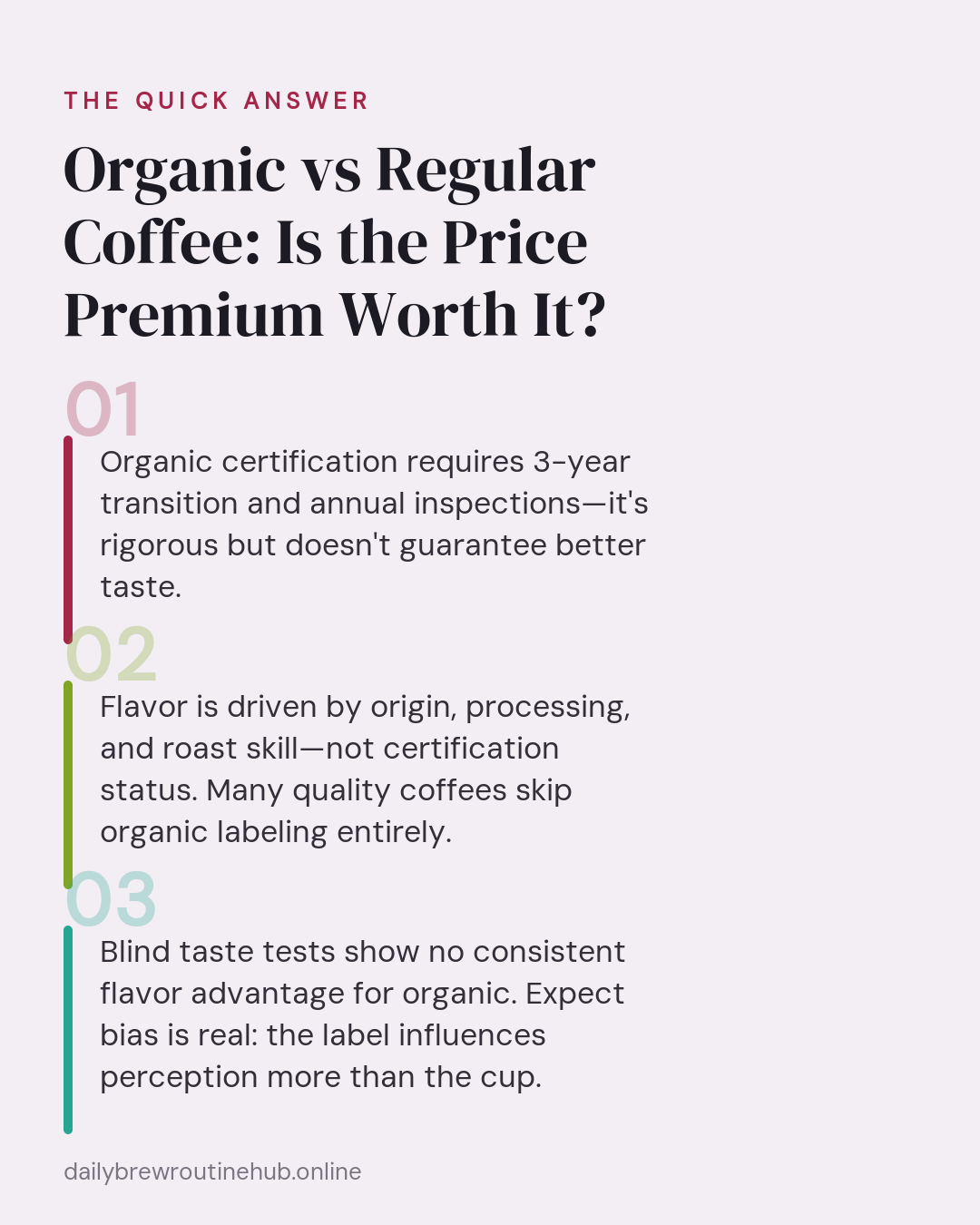
- Organic certification requires 3-year transition and annual inspections—it's rigorous but doesn't guarantee better taste.
- Flavor is driven by origin, processing, and roast skill—not certification status. Many quality coffees skip organic labeling entirely.
- Blind taste tests show no consistent flavor advantage for organic. Expect bias is real: the label influences perception more than the cup.
Organic Coffee vs Regular Coffee: Is It Actually Worth the Higher Price?
You’re standing in the coffee aisle, staring at two bags of medium roast from the same region. One is $14. The other is $22 and has a USDA Organic seal. Is that extra $8 actually doing anything — or are you paying for a sticker?
It’s one of the most common questions home brewers ask once they start getting serious about their coffee. And the honest answer is more nuanced than either the organic marketing copy or the dismissive “it’s all a scam” crowd will tell you.
Let’s break it down properly.
What “Organic” Actually Means on a Coffee Bag
Before you can decide whether organic coffee is worth buying, you need to know what you’re actually buying.
USDA Organic certification has a specific, legally enforceable meaning. To earn it, a farm must:
- Avoid all synthetic pesticides, herbicides, and fertilizers
- Maintain soil fertility through approved organic methods (composting, cover crops, etc.)
- Keep its land free from prohibited substances for at least three years before certification
- Submit to annual inspections by a USDA-accredited certifier
That three-year transition period matters. A farm can’t swap inputs overnight and slap a label on bags. The certification process is rigorous — and expensive.
Here’s where the nuance kicks in: not all high-quality coffee is certified organic, and not all certified organic coffee is high quality. Many small specialty farms operate using organic practices without pursuing certification — because the paperwork, audit fees, and compliance tracking can add 10–15% to farm production costs, which is prohibitive for small growers with thin margins. So you can absolutely find conventionally labeled coffee grown with minimal chemical inputs.
The label tells you about the process. It doesn’t tell you everything about the product.
Does Organic Coffee Actually Taste Better?
Short answer: no — not reliably, and not because it’s organic.
Flavor in coffee is primarily driven by:
- Origin and altitude (Ethiopian Yirgacheffe and Guatemalan Antigua taste the way they do for geographic reasons, not certification status)
- Processing method (washed vs. natural vs. honey-processed dramatically changes flavor profile)
- Roast date (stale beans taste worse regardless of how they were grown)
- Roast level and roaster skill
Some organic farms use traditional shade-growing methods — growing coffee under a canopy of trees — which slows cherry development and can increase cup complexity. But shade-growing correlates with organic farming because both tend to be associated with smaller, more traditional operations. The shade is doing the flavor work, not the organic certification itself.
Blind taste tests don’t consistently favor organic coffee. Expectation bias is real: when people know they’re drinking organic, they often rate it higher. When the label is hidden, the results get much murkier. If flavor is your primary driver, you’ll get more reliable improvements from chasing better origins and roast dates than from the USDA seal.
The Pesticide Question: What the Research Actually Shows
This is where things get genuinely complicated — and where a lot of organic coffee marketing oversimplifies.
Conventional coffee is among the most chemically treated agricultural crops globally. Farmers working with conventional methods are regularly exposed to synthetic pesticides and herbicides during spraying and harvest. That’s a real concern — for farmworkers, not necessarily for you as the end consumer.
Why? Because coffee beans are roasted at very high temperatures before they reach your cup. Most pesticide residues — if any remain after processing — are significantly degraded by roasting. The EPA sets tolerance levels for pesticide residues on food crops, and both organic and conventional coffees sold in the US must fall within those limits.
But here’s the finding that surprises most people: even organic coffee can contain trace contaminants. Independent testing (including a 2022 study published in Frontiers in Public Health) found trace amounts of heavy metals — lead, arsenic, and cadmium — in both organic and conventional coffee samples. All samples tested fell within EU safety limits per serving, but it’s a reminder that “organic” doesn’t mean “zero contaminants.” Environmental contamination of soil and water doesn’t respect certification boundaries.
Organic certification prohibits glyphosate use, and that matters for reducing intentional spraying. But it’s not a complete contamination shield.
Health Claims: Where the Evidence Stops
Let’s be direct about this, because organic coffee marketing loves to push health benefits that the science doesn’t actually support.
Marketing claims that organic coffee contains “significantly more antioxidants” are not backed by scientific consensus. One peer-reviewed study (Springer Nature, 2011) found higher levels of chlorogenic acid, caffeine, and trigonelline in organic samples compared to conventional — but the differences didn’t produce meaningfully different physiological outcomes in the study models.
Caloric content? A standard 8-ounce cup of either organic or conventional coffee contains approximately 2 calories. No difference.
Bottom line: if you’re buying organic coffee primarily for personal health benefits, the evidence doesn’t justify the premium. That’s not a knock on organic farming — it’s just an honest read of what the current science actually shows.
The Environmental Case: This Is Where Organic Wins
If you’re buying organic for sustainability reasons, the argument is much stronger — just not in the way it affects your cup.
Organic farming practices deliver real environmental benefits:
- Reduced synthetic chemical runoff in coffee-growing regions, which protects local watersheds and aquatic ecosystems
- Improved soil health over time through composting and cover-cropping
- Biodiversity gains — organic and shade-grown farms tend to support more bird species and insect populations than monoculture conventional farms
- Farmworker safety — reduced exposure to synthetic pesticides during cultivation and harvest
According to the National Coffee Association’s 2023 Specialty Coffee Report, 56% of specialty coffee drinkers in the US said they’re more likely to buy organic-certified coffee. That consumer signal is driving market growth — Grand View Research projects the US organic coffee market will reach $2.8 billion by 2030, growing at roughly 9% annually.
That growth reflects genuine consumer values — just make sure you’re clear on which values organic certification is actually serving.
Where Your Extra Money Is Actually Going
When you pay $22 for an organic bag versus $14 for conventional, the premium breaks down something like this:
- Certification overhead: Annual audits, compliance documentation, and certifier fees add real production costs — often 10–15% at the farm level
- Scale disadvantage: Smaller organic farms lack the economies of scale that larger conventional operations use to lower per-unit cost
- Roaster and retail markup: Some roasters price fairly based on their actual sourcing costs. Others use the organic label to inflate margins. The label alone doesn’t tell you which you’re dealing with.
- Supply chain complexity: Certified organic beans must be kept segregated throughout processing and shipping to maintain certification — that adds logistical cost
The takeaway: the premium is real and partly justified. But it varies enormously by roaster. A $22 organic bag from a transparent, well-reviewed specialty roaster with visible sourcing information is a very different purchase than a $22 organic blend from a mass-market brand with zero origin information on the label.
Smarter Alternatives If Budget Is a Factor
You don’t have to choose between quality and spending $25 per bag. Here’s what actually moves the needle on your home brewing:
Prioritize roast date over certification. Fresh beans — roasted within the last 2–4 weeks — will outperform stale organic beans every single time. Look for a roast date on the bag (not a “best by” date — those are not the same thing).
Buy from specialty roasters with transparent sourcing. A roaster that names the farm, the region, the processing method, and the harvest season is giving you far more useful information than a USDA seal on an anonymous blend. That sourcing transparency often indicates better quality at the farm level — with or without organic certification.
Look at Fair Trade and Rainforest Alliance certifications if farmworker welfare and sustainability are your priority. These certifications cover labor practices and environmental standards in ways that organic certification alone doesn’t address. For many buyers, a Fair Trade or Rainforest Alliance-certified conventional coffee is a better ethical choice than an organic coffee with opaque sourcing.
Subscription services from specialty roasters often deliver better per-pound pricing than retail bags — organic or conventional — and you get fresher beans shipped closer to the roast date.
The Verdict: When to Buy Organic, When to Skip It
Here’s the honest summary:
Buy organic if: You care about farmworker safety and reduced pesticide exposure at the growing level, you trust the specific roaster’s sourcing practices, and the price difference fits your budget comfortably.
Skip organic if: You’re primarily chasing better flavor — organic certification is not a reliable predictor of cup quality. Focus that budget on better origins, fresher roast dates, and roasters with strong reputations.
The real sweet spot: Find a specialty roaster you trust — one that publishes sourcing information, ships freshly roasted beans, and has a strong track record in communities like r/Coffee. If they happen to carry organic options, great. If their best beans aren’t certified organic, that’s fine too.
Organic coffee isn’t a scam. It’s a real certification with real costs and real environmental benefits. But it’s a poor proxy for quality, and for most home brewers optimizing flavor per dollar, origin and freshness will take you further than the USDA seal.
Spend your premium on a better roaster. The cup will show it.
Sources
- Organic Coffee vs Regular Coffee A Complete Guide – Peak Performance
- Organic vs. Non-Organic Coffee: What Are the Differences? – Colipse
- Organic vs. Conventional Coffee — Equal Exchange Resource Center
- The Importance of Organic When it Comes to Coffee – Purity Coffee
- Organic Coffee: Benefits, Risks & How to Choose the Healthiest Cup
- Organic Coffee vs Regular Coffee | U3 Coffee