TL;DR
- Use a scale, not eyeballing: 1:16 ratio (pour-over/drip) or 1:15 (French press) as your starting baseline.
- Example: 350 ml water = 22g coffee at 1:16. Use the dose table to find your exact grams in seconds.
- Small dose changes (3–5g) create big flavor swings—precision here beats expensive beans every time.
How Much Coffee Per Cup? A Dosing Routine for Pour-Over, French Press, and Drip
You’ve brewed the same beans three days in a row and gotten three completely different cups. Sound familiar? The beans didn’t change. Your water temperature was probably fine. The culprit is almost always your dose — and fixing it takes less than two minutes.
Coffee dosing is the one variable most home brewers eyeball, and it’s the one that matters most for consistency. This guide gives you exact numbers for pour-over, French press, and drip, plus a simple framework for adjusting when something tastes off.
Why Your Coffee Tastes Different Every Morning
Small changes in how much coffee you use produce surprisingly large changes in flavor. Too much coffee and you get a heavy, bitter cup where the grounds have been extracted too hard. Too little and the water has nothing to hold onto — the result is thin, sour, and flat.
Here’s the part most guides skip: the problem isn’t usually the ratio you’re aiming for. It’s that you’re not measuring consistently. A heaping tablespoon of finely ground coffee and a loose tablespoon of coarse coffee can differ by 3–5 grams. At a 1:16 ratio, a 4-gram swing in coffee dose shifts your effective ratio by more than half a cup’s worth of water. That’s not a minor tweak — it’s the difference between a café-quality cup and something you pour down the sink.
The fix is simple: use a scale. We’ll come back to that.
The Golden Ratio: Where to Start
The Specialty Coffee Association (SCA) has established what they call the Golden Cup Standard — a benchmark for brewing ratios that produces coffee within an optimal flavor range. Their general recommendation is approximately 1 gram of coffee per 18 grams of water (a 1:18 ratio), or roughly 55 grams of coffee per liter of water.
That said, the SCA also recognizes method-specific adjustments:
- Pour-over and drip: 1:16 (stronger flavor extraction, shorter contact time)
- French press: 1:15 (heavier body, oils present, slightly stronger dose to balance)
- General/flexible: 1:18 as a lighter starting point for mild preference
These aren’t guesses — they reflect how extraction works differently across methods. Use them as your starting baseline, then adjust the ratio slightly in either direction based on taste.
Quick mental math: Multiply your water weight (in grams) by 0.0625 for a 1:16 ratio, or by 0.0667 for a 1:15 ratio. Or just use the table below.
| Water | 1:15 (French Press) | 1:16 (Pour-Over/Drip) | 1:18 (Lighter) |
|---|---|---|---|
| 300 ml | 20 g | 19 g | 17 g |
| 500 ml | 33 g | 31 g | 28 g |
| 1000 ml | 67 g | 63 g | 56 g |
Pour-Over Dosing: Precision Pays Off Here
Pour-over is the method most sensitive to dosing changes — because you control every variable manually, there’s no machine to compensate. Start with a 1:16 ratio.
A practical example:
– Brewing 350 ml of water → 350 ÷ 16 = 22 grams of coffee
– Brewing 500 ml → 500 ÷ 16 = 31 grams
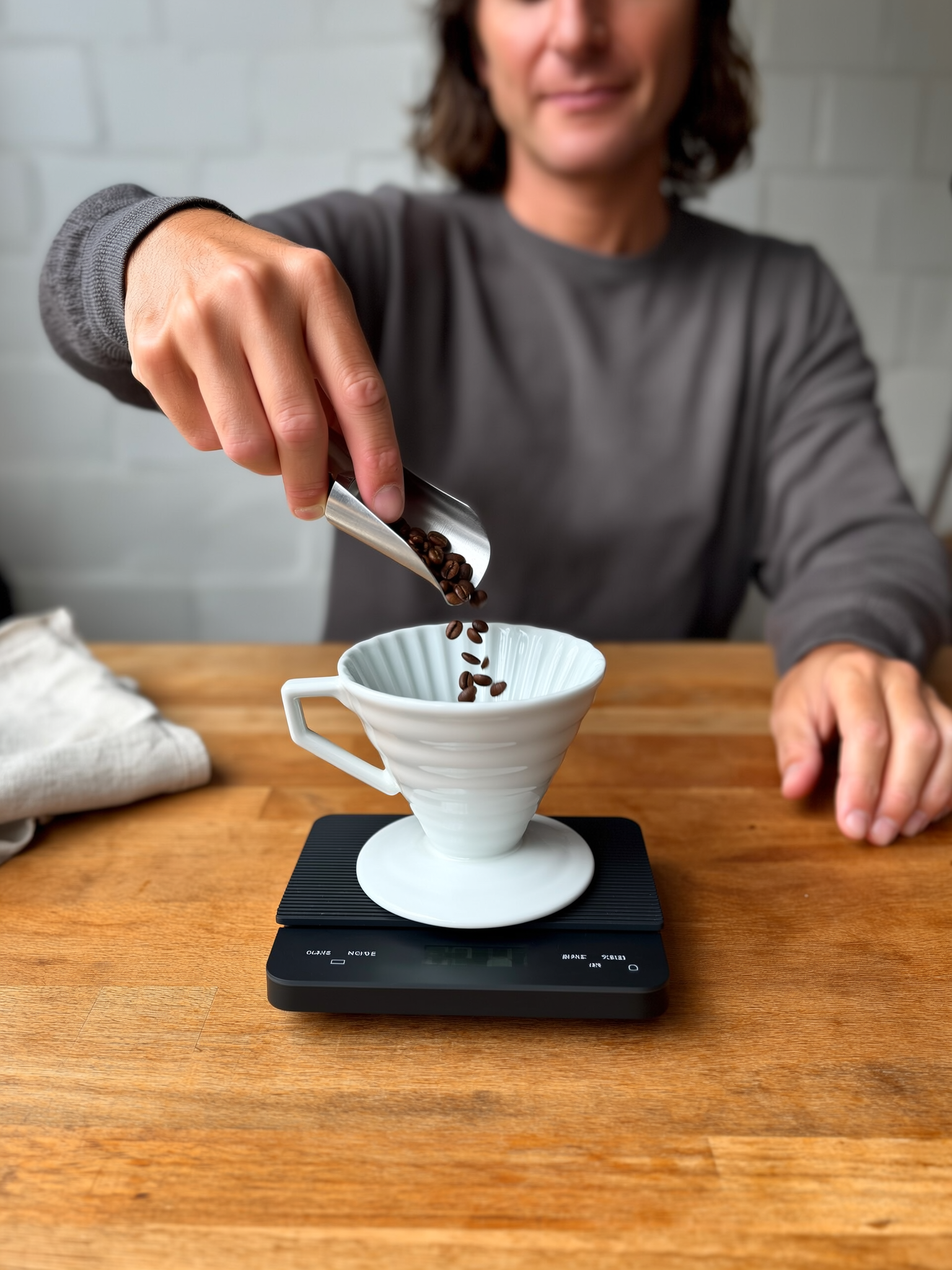
Weigh your water first (or know your kettle’s capacity), then calculate your coffee dose. Don’t do it the other way around — it’s easy to overshoot your target water if you’ve already committed to a coffee weight.
Grind for pour-over: Medium-fine. Think slightly coarser than table salt. Too fine and you’ll choke the flow; too coarse and water rushes through without extracting properly.
What most guides miss on pour-over dosing: Your dose should stay fixed even as your pour stages change. Many beginners assume pouring in three stages (bloom, main, finish) means they should adjust how much coffee they use. It doesn’t. The multi-stage pour is about managing extraction speed and evenness — not about compensating for a wrong dose. Get the dose right first, then work on your pour technique.
Light roast or single-origin beans? Consider nudging slightly toward 1:17. Their higher density and more complex flavor compounds can get muddy at 1:16.
French Press: Why You Need More Coffee Than You Think
French press works through full immersion — grounds sit in water for the entire brew, rather than water flowing through them. The metal mesh filter doesn’t remove the coffee oils, so you get a heavier, more textured cup.
Because of this, French press is typically brewed at a 1:15 ratio — a bit stronger than pour-over to balance that heavier body and account for the gentler extraction dynamics.
Practical doses for common French press sizes:
- 12 oz / 350 ml press: ~23 grams of coffee
- 17 oz / 500 ml press: ~33 grams of coffee
- 34 oz / 1 liter press: ~67 grams of coffee
Grind: Coarse. This is non-negotiable. Fine grinds in a French press create two problems — they slip through the mesh into your cup, and they over-extract during the 4-minute steep, producing bitter, gritty coffee. Aim for a consistency closer to rough sea salt or coarsely cracked pepper.
The common mistake: Under-dosing French press because the coffee looks like “a lot.” At 67 grams for a liter, you’ll second-guess yourself. Don’t. Under-dosing produces a weak, watery cup that the heavy mouthfeel makes even more noticeable.
Brew time: 4 minutes steep before pressing. Don’t adjust your dose to compensate for steep time — if you want stronger coffee, add more grounds, don’t steep longer. Extended steep time mostly adds bitterness, not strength.
Drip Machine Dosing: The Consistency Problem
Automatic drip machines are convenient, but they invite inconsistency because most people use the built-in scoop or go by volume. Here’s the issue: coffee grounds compress differently depending on roast level and grind size. A standard coffee scoop (~2 tablespoons) can hold anywhere from 8 to 14 grams depending on how coarsely it’s ground and how densely it’s packed.
The SCA’s weight-based standard cuts through this entirely. For drip:
- Target ratio: 1:16
- 12-cup machine (typical capacity ~1.8 liters): approximately 112 grams of coffee
- 8-cup machine (~1.2 liters): approximately 75 grams
- Half-pot (6 cups, ~900 ml): approximately 56 grams
Most people brewing a “12-cup” pot are using 40–60 grams of coffee. That’s why home drip coffee often tastes weak and flat compared to café drip — it’s chronically under-dosed.
Machine markings are a guide, not gospel. The “cup” markers on drip machines are usually based on 5–6 oz servings, not the 8–12 oz mugs most of us actually use. If your machine says “12 cups” but you’re filling a large travel mug twice, account for your actual water volume.
OXO Brew 9-Cup Coffee Maker with Scale
The Weight Measurement Rule (Non-Negotiable)
The SCA is explicit on this: volume measurement introduces too much variability for consistent results. Ground coffee’s density changes with roast level, grind size, and even humidity. A scale removes all of that guesswork.
You don’t need anything fancy. A digital kitchen scale with 0.1-gram accuracy is enough — and it will improve every brew method you use, not just coffee.
A practical system:
1. Place your dripper, French press, or machine basket on the scale
2. Tare to zero
3. Add coffee until you hit your target weight
4. Brew
That’s it. Once you’ve done this a dozen times, the dose for each method becomes automatic. The scale becomes a confirmation tool, not a chore.
Adjusting When Something Tastes Off
Even with a correct ratio, taste is subjective and beans vary. Here’s a simple diagnostic:
If your coffee tastes sour or thin:
– First check: Is your water hot enough? (SCA recommends 93°C ±3°C)
– If temperature is fine: Increase your dose by 5–10%, or grind slightly finer
If your coffee tastes bitter or harsh:
– First check: Is your grind too fine for your method?
– If grind seems right: Reduce dose slightly (try 1:17 instead of 1:16), or coarsen your grind
Light roast vs. dark roast adjustments:
– Light roasts and single-origin beans are more complex and benefit from a slightly lower dose — 1:17 or even 1:18 — to let delicate flavors express without muddiness
– Dark roasts and blends handle a higher dose (1:15 or 1:16) without becoming unpleasant, because the roasting process has already developed bolder, more resilient flavor compounds
One variable at a time. This is the rule most beginners break. If your brew tastes wrong, change either your dose or your grind — not both at once. Otherwise you won’t know which change fixed it (or made it worse).
Building a Dosing Routine That Sticks
Consistency doesn’t require discipline — it requires a system. Here’s one that works:
Step 1: Pick your starting ratio. Use the SCA-based numbers above for your brew method.
Step 2: Write it down. Seriously. Keep a simple note on your phone or stick a Post-it near your coffee station: “Pour-over: 22g coffee / 350ml water.” Do this for each method and each bean type you rotate through.
Step 3: Note what worked. After a brew you enjoyed, log the dose, grind setting, and any tweaks. This becomes your reference baseline when you open a new bag of beans.
Step 4: Use a scale every time. Not just occasionally. The scale is the only thing standing between repeatable café-quality brews and morning lottery coffee.
One More Thing: Caffeine and Dose
A quick note for anyone tracking caffeine intake: adjusting your coffee dose does affect how much caffeine ends up in your cup, but the relationship isn’t perfectly linear, and caffeine content varies significantly by bean, roast, and brew method.
The FDA has noted that for most healthy adults, up to 400 mg of caffeine per day is not generally associated with negative effects. If you’re pregnant, trying to conceive, or breastfeeding, current guidance recommends staying under 200 mg per day — check with your doctor for your specific situation. Children and adolescents should avoid caffeine, per the American Academy of Pediatrics.
What this means practically: if you’re watching your caffeine intake, pay attention to your total water volume and brew count, not just your dose per cup. A stronger dose per cup isn’t automatically more caffeine if you’re drinking fewer cups total.
The Bottom Line
Coffee dosing isn’t complicated — it just requires two things most home brewers skip: a scale and a written baseline.
Use the SCA-grounded ratios as your starting point: 1:16 for pour-over and drip, 1:15 for French press. Weigh your coffee every time. Adjust one variable when something’s off. Write down what works.
Do that for two weeks and your morning cup stops being a gamble. That’s the whole routine.
Sources
- The Ideal Water Ratios For Drip, Pour Over, And French Press Coffee – Food Republic
- Coffee to Water Ratio: Coffee Brew Ratio Guide – Stone Creek Coffee
- Coffee To Water Ratio For French Press, Drip, Pour-Over, AeroPress and – Nowhere Coffee Club
- Coffee to Water Ratio Calculator: The Ultimate Coffee Brewing Tool – Coffee Bros.
- Coffee to Water Ratio by Brew Method (With Charts)
- Coffee to Water Ratio: Every Method, Every Cup Size (2026)