TL;DR
- Electric gooseneck kettles give you precise temperature control and steady pour rate that stovetop kettles cannot match.
- Fellow Stagg EKG is the premium choice with ±1°F accuracy and 60-minute hold mode; Pro version adds Bluetooth and auto-on.
- Budget options exist and work well for beginners; compare features and decide what temperature precision actually matters for your brew.
Best Electric Gooseneck Kettles for Pour-Over Coffee: Fellow Stagg vs. Bonavita vs. Budget Options
Your pour-over technique isn’t the problem — your kettle might be. The best electric gooseneck kettles for pour-over coffee give you precise temperature control and a controlled flow rate that a standard stovetop kettle simply can’t match, and the difference shows up immediately in your cup.
If you’ve been getting bitter or sour extractions despite following a solid recipe, inconsistent water temperature is a likely culprit. The SCA’s brewing standard calls for 195–205°F at the moment water contacts the grounds — and a wide-spout kettle you lifted off the stove 90 seconds ago could easily be 15°F off that window without you knowing it.
Here’s a clear breakdown of what each tier actually offers, what you’re trading off, and which kettle makes sense for where you are right now as a home brewer.
Why Electric Gooseneck Kettles Have Become Essential for Pour-Over
The gooseneck spout isn’t just aesthetic. That long, narrow, curved neck restricts and steadies your water flow — giving you even saturation across the coffee bed, controlled agitation, and more predictable extraction than any wide-spout kettle can deliver. Slow, spiraling pours are what allow a bloom to work properly and what prevent channeling in a dripper.
Add electric precision temperature control to that spout, and you’ve got something genuinely powerful: the ability to hit a specific temperature, hold it, and repeat the same result every single morning.
Pour-over content featuring gooseneck kettles now dominates the #homebarista feed on TikTok, and Pinterest aesthetic boards have made the sleek silhouette of a Fellow Stagg nearly as recognizable as a Chemex. Beginners aren’t waiting until they’re “serious enough” anymore — they’re buying gooseneck kettles as their first meaningful brewing upgrade.
Fellow Stagg EKG: The Premium Pick
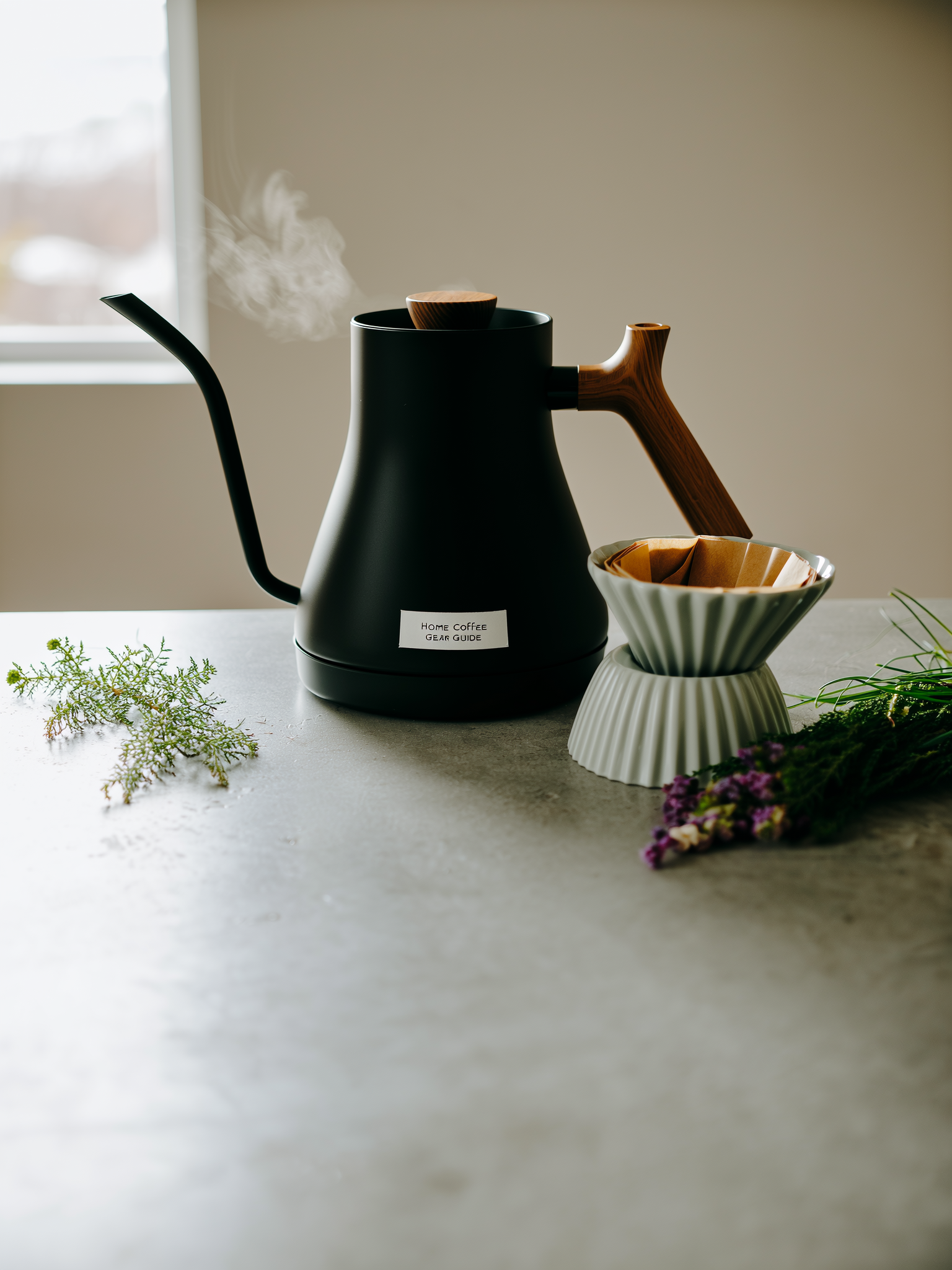
Fellow Stagg EKG Electric Gooseneck Kettle
The Fellow Stagg EKG runs at 1200 watts, reaches a full boil in around 5 minutes, and holds your target temperature with ±1°F accuracy. Its temperature range spans 135°F to 212°F — wider than most competitors — which matters if you brew lighter roasts that extract better around 205°F or experiment with green tea at lower temperatures.
The hold mode offers four presets: 15, 30, 45, or 60 minutes. That 60-minute window is genuinely useful if you’re brewing multiple cups across a slow morning rather than one quick batch.
Pricing runs $165–$195 depending on color, with the Stagg EKG Pro stepping up to $195–$215. The Pro adds Bluetooth connectivity, a color screen, auto-on programming, altitude compensation settings, and a chime when your water hits temperature. If you’re the type to log your brews and dial in variables systematically, the Pro is worth the jump. If you just want to nail your daily V60, the standard EKG delivers everything you actually need.
The integrated brew timer on the EKG is a genuinely useful feature that most guides overlook. You start timing directly from the kettle rather than fumbling for your phone, which means one less variable during a pour that requires focused attention.
Who it’s for: Daily brewers who are already invested in their pour-over setup — good grinder, quality beans, consistent ratio — and want their kettle to match that level. If you’re brewing five or more cups a day and care about repeatability, the Stagg earns its price.
Bonavita Variable Temperature: The Smart Mid-Range Choice
Bonavita Variable Temperature Gooseneck Kettle
The Bonavita Variable Temperature Gooseneck Kettle is the one to buy if you want real performance without the Fellow price tag. It runs a 1000-watt element, reaches target temperatures in approximately 6 minutes, and holds at ±2°F accuracy — genuinely solid for home brewing.
Temperature range sits between 140°F and 208°F with one-degree increment adjustments and six preset options. The 60-minute hold function matches the Fellow. The Classic model runs $99.99; the Cosmopolitan version with a different handle design costs $129.99.
Expert reviewers consistently describe the Bonavita as the best value in the mid-range market and highlight its rock-solid reliability as a standout trait. In practical terms: the temperature doesn’t drop noticeably mid-pour, which is the failure mode that actually matters during a four-minute Chemex brew.
What you’re giving up compared to the Fellow: the ±2°F variance versus ±1°F (meaningful for very light roasts, negligible for most home brewers), no brew timer on the kettle itself, and a design that’s functional rather than display-worthy.
Who it’s for: Intermediate brewers ready to graduate from manual or stovetop kettles. If you’ve been using a basic gooseneck without temperature control and you’re frustrated by inconsistency, the Bonavita solves the problem at half the Fellow’s price.
Budget Electric Gooseneck Kettles Under $50–$70: Honest Trade-offs
The budget tier — brands like Cosori, Chefman, Greater Goods, and Aigostar — has improved meaningfully over the past few years. The Cosori electric gooseneck sits at roughly $70 and is frequently recommended as the value pick at this price point. The Greater Goods 1L model uses a 1200-watt element and claims boil times of 3–5 minutes.
These kettles offer gooseneck convenience and basic temperature presets, which puts them ahead of any stovetop setup. But there are real limitations worth understanding before you buy:
- Temperature stability: Budget heating elements heat unevenly and cool faster once they cut off. You might hit 200°F but drop to 193°F by the end of a longer pour.
- Hold precision: Basic models hold temperature loosely, with wider variance than the Bonavita’s ±2°F — exact figures vary by model, so check third-party tests before assuming.
- Spout quality: Lower-cost spouts can drip at the tip or lack the ergonomic balance of mid-range models. Read Amazon reviews specifically for “drip” and “spout” complaints on whichever model you’re considering — this varies significantly even within budget brands.
- Durability: Plan realistically. If pour-over becomes a daily habit and you’re still using a budget kettle in 18 months, it’s probably time to upgrade anyway.
Who it’s for: Beginners testing whether gooseneck brewing is actually worth the investment in better gear and technique. If you brew once or twice a week and aren’t sure yet whether you’ll stick with pour-over, a $50–$70 entry-level kettle is a reasonable starting point. Just don’t expect Bonavita consistency.
Head-to-Head: What Each Kettle Actually Wins On
| Feature | Fellow Stagg EKG | Bonavita Variable Temp | Budget Options |
|---|---|---|---|
| Temperature range | 135–212°F | 140–208°F | Varies (often 104–212°F) |
| Temp accuracy | ±1°F | ±2°F | Unverified / wider variance |
| Wattage | 1200W | 1000W | 1000–1200W (varies) |
| Hold function | Up to 60 min | Up to 60 min | Limited / inconsistent |
| Brew timer | Yes (on kettle) | No | No |
| Price | $165–$215 | $99–$129 | $30–$70 |
The Fellow wins on precision, integrated features, and aesthetics. The Bonavita wins on value — it delivers the core performance you actually need at a price most brewers can justify. Budget options win on accessibility for beginners who aren’t sure yet.
One thing most comparisons miss: if you’re extracting single-origin light roasts that benefit from temperatures in the 200–205°F range, the ±1°F vs. ±2°F gap between Fellow and Bonavita is largely theoretical for home brewing. The SCA’s 195–205°F target is a range, not a single point. Neither kettle will hold you to such a tight corridor that a 1°F difference meaningfully changes your cup — unless you’re testing extremely dialed-in recipes in controlled conditions.
How to Choose Based on Your Actual Brewing Routine
Ask yourself these questions before buying:
How often do you brew pour-over?
– 1–2 times per week → budget kettle is fine for now
– Daily brewer → Bonavita is the minimum worth buying
– Multiple cups every morning, serious about dialing in → Fellow Stagg EKG justifies the cost
What beans are you using?
– Pre-ground or commodity blends → temperature precision matters less
– Single-origin, lightly roasted specialty beans → you’ll get real value from mid-range and up
Do you care about the kettle timer?
This is a more useful feature than it sounds. If you’re timing your pours — and you should be — having the timer on the kettle means two hands free and one fewer device on the counter. The Fellow’s built-in timer is a genuine workflow improvement if you brew attentively.
Does aesthetics matter to your setup?
Honest answer: for a lot of home baristas, yes. The Fellow Stagg is genuinely beautiful on a counter and that’s a legitimate reason to buy it if the price fits your budget. The Bonavita is clean and functional. Budget models vary — some look decent, some don’t.
Where Gooseneck Kettles Are Headed in 2026
The category has normalized. A gooseneck kettle is no longer specialty gear that requires explanation — it’s the expected starting point for any home pour-over setup. The conversation has shifted from “should I get one?” to “which tier makes sense for me?”
The next wave is connected brewing. The Fellow Stagg EKG Pro’s Bluetooth integration and app logging features represent where the category is heading — kettles that sync with brew logs, auto-start based on your schedule, and adjust temperature profiles per bean. Early adopters who started with standard electric goosenecks are already upgrading to connected models.
For most home brewers right now, the Bonavita hits the sweet spot: real temperature precision, reliable hold, and a price that doesn’t require a committed specialty coffee identity to justify. If you’re already serious, the Fellow Stagg EKG is the upgrade worth saving for. And if you’re just starting? A Cosori or Greater Goods at $50–$70 is a legitimate entry point — just know what you’re trading off.
The best kettle is the one that removes inconsistency from your morning routine and makes you want to brew more intentionally. All three tiers do that relative to a stovetop kettle. The question is just how much precision you want to pay for right now.
Frequently Asked Questions
Does an electric gooseneck kettle actually improve pour-over coffee?
Yes. Precise temperature control keeps water within the SCA brewing standard of 195–205°F, and the gooseneck spout’s narrow neck gives you steady, controlled flow that prevents channeling and allows proper bloom saturation — both directly improve extraction consistency.
What temperature should I use for pour-over coffee?
The SCA brewing standard calls for 195–205°F at the moment water contacts the grounds. Lighter roasts extract better around 205°F, while darker roasts may benefit from slightly cooler water around 195–200°F. An electric kettle with temperature presets removes the guesswork.
Is the Fellow Stagg EKG Pro worth the extra money over the standard EKG?
The Pro adds Bluetooth connectivity, a color screen, auto-on scheduling, altitude compensation, and a chime — useful if you log brews and dial in variables systematically. The standard EKG delivers full temperature control and hold mode without those features at a lower price.
How long does the Fellow Stagg EKG take to boil water?
The Fellow Stagg EKG reaches a full boil in around 5 minutes at 1200 watts and holds your target temperature with ±1°F accuracy across a range of 135°F to 212°F.
Sources
- Fellow Stagg EKG Electric Gooseneck Kettle | Pour-Over Kettles | Williams Sonoma
- Fellow Stagg EKG Pro Gooseneck Kettle | Seattle Coffee Gear
- Fellow Stagg EKG Electric Kettle | Equator Coffees
- Fellow Stagg EKG Electric Kettle | Costco
- Stagg EKG Electric Goose Neck Kettle by Fellow | Bones Coffee
- Stagg EKG Pro Electric Gooseneck Kettle Black – FELLOW | Specialty Hub