TL;DR
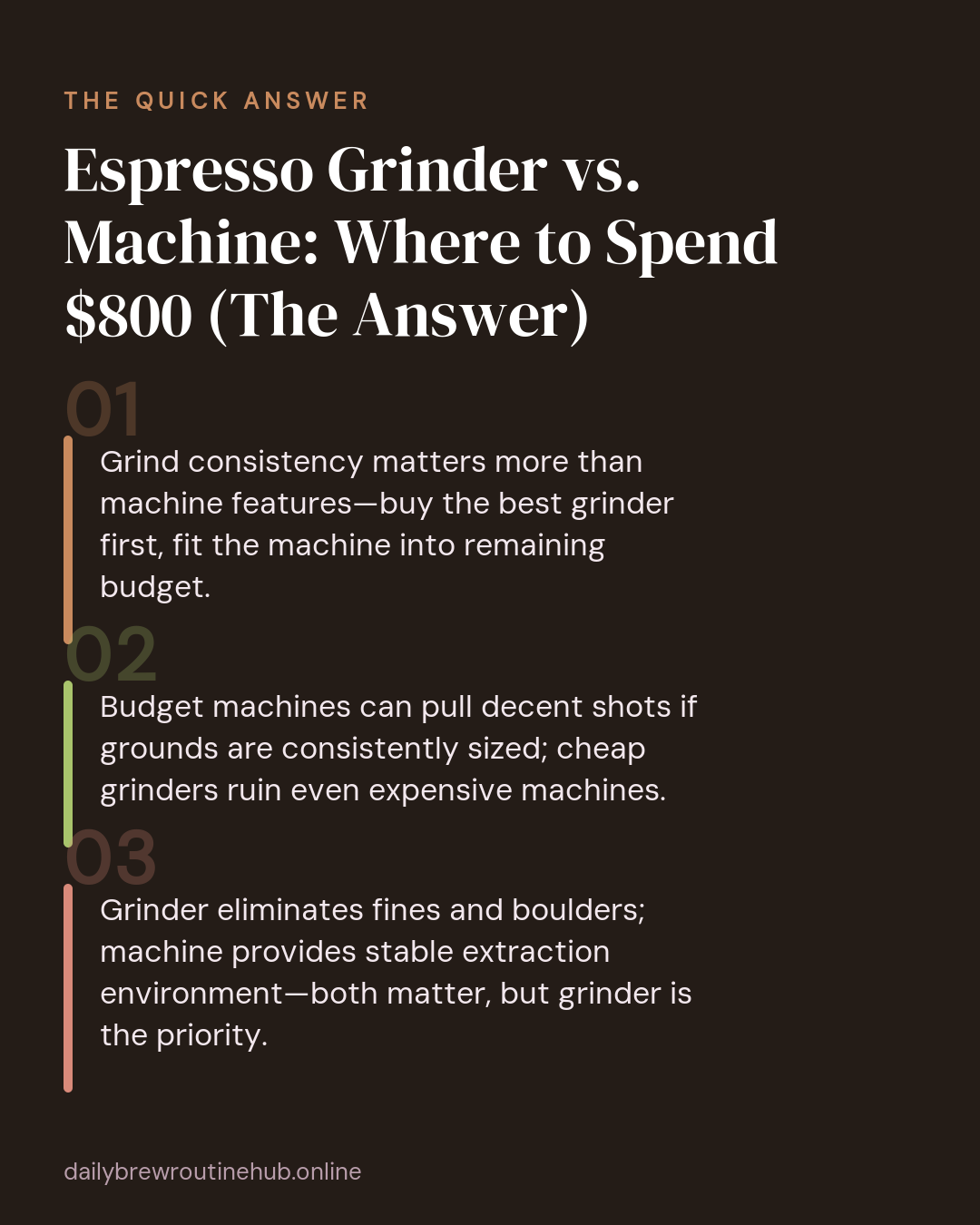
- Grind consistency matters more than machine features—buy the best grinder first, fit the machine into remaining budget.
- Budget machines can pull decent shots if grounds are consistently sized; cheap grinders ruin even expensive machines.
- Grinder eliminates fines and boulders; machine provides stable extraction environment—both matter, but grinder is the priority.
Cheap Espresso Machine + Expensive Grinder vs. Expensive Machine + Cheap Grinder: Where Should Your Money Actually Go?
You’ve got $800 to build your home espresso setup, and every forum thread you read tells you something different. Some say save on the machine, others swear you need the fancy boiler. Here’s the short answer before we dig into the why: buy the best grinder you can afford, then fit the machine into whatever’s left.
That’s not a hot take—it’s what specialty coffee educators, seasoned home baristas, and even commercial café trainers have been saying for years. But understanding why the grinder wins this argument will help you make smarter decisions at every future gear upgrade, not just your first purchase.
The Real Reason Grinder Quality is Non-Negotiable
Espresso is an unforgiving brew method. Water contacts your coffee grounds under pressure for roughly 25–30 seconds. That’s it. There’s almost no margin for error, and the grinder is where errors begin.
When a budget grinder cuts coffee beans, it doesn’t produce a clean, uniform particle size. Instead, you get a mix of fines (dust-like particles) and boulders (oversized chunks). In that 25-second window, the fines over-extract and turn bitter, while the boulders under-extract and stay sour. Your cup ends up tasting like both problems at once—harsh and flat.
A quality burr grinder, by contrast, cuts beans to a consistent particle size at the micron level. Water flows through evenly, extracts evenly, and the result is a balanced shot. The burr design matters here too. Flat and conical burrs behave differently in terms of heat generation and flavor expression, but both outperform blade-style or cheap pressed-metal burrs by a significant margin.
The bottom line: grind consistency is the single biggest variable you can control for better espresso, and it shows up in every cup.
What a Budget Machine Actually Limits (and What It Doesn’t)
Entry-level espresso machines have real limitations. Temperature fluctuations are common—the heating element overshoots or undershoots, and your extraction window narrows. Cheap group heads don’t always distribute water evenly across the puck, which can cause channeling: water finding the path of least resistance through the grounds rather than flowing evenly through them. Channeling wastes beans and pulls uneven shots.
Parts wear out faster too. A heating element replacement or pump service on a cheap machine can creep up on you after 18 months of daily use.
But here’s what a budget machine can do: it can maintain enough pressure to pull a shot. If that shot is built on consistently ground coffee, you’re already most of the way to a drinkable, even enjoyable espresso. The machine provides the extraction environment; the grinder determines how clean that extraction can get.
More expensive machines earn their price tag through temperature stability and consistency, better materials, and more refined water distribution. Those are real advantages—but they’re diminishing returns unless the foundation (your grind) is already solid.
Expensive Grinder + Budget Machine: Why This Combination Wins
Here’s a test case that illustrates the principle clearly: a senior editor at a specialty coffee publication once claimed he could pull better shots with a $200 machine paired with a $400 grinder than with a $4,500 espresso machine hooked up to a $50 blade grinder. The price tags flip the intuition completely—but the logic holds.
A quality burr grinder in the $200–$400 range produces the kind of consistency that papers over a modest machine’s weaknesses. Here’s why this pairing works so well in practice:
- Fewer variables to troubleshoot. When you’re learning espresso, having one reliable input (your grind) means you can actually diagnose what’s going wrong. With a bad grinder, everything is unpredictable.
- You develop technique faster. Dialing in a consistent grinder teaches you how grind size affects shot time and flavor. That’s a skill that transfers to every machine you’ll ever own.
- Budget machines have improved. In 2026, the gap between entry-level and mid-range machines has narrowed meaningfully. A well-reviewed $200–$250 machine from a proven brand can deliver acceptable temperature stability and pressure for daily use.
- Upgrading later is straightforward. When you’re ready to spend more on a machine, your grinder comes with you. The investment carries forward.
Good grinders have also become more accessible price-wise. What once cost $600 can now be matched in performance for around $300, and solid capable options exist from around $200. The barrier to getting a genuinely good grind has dropped considerably.
Expensive Machine + Budget Grinder: Why This Backfires
Now flip the pairing. Say you stretch your budget to a $700 or $800 semi-automatic machine with a PID temperature controller, a quality group head, and a commercial-style portafilter—and you pair it with a $45 grinder.
The machine does everything right. Water hits the puck at exactly 93°C with 9 bars of pressure, evenly distributed. And then the grinder drops a mess of fines and boulders into that portafilter.
No machine, regardless of how much it costs, can fix an inconsistent grind. The physics don’t allow it. Uneven particle sizes extract unevenly—full stop. You’ll get channeling, short shots, over-extracted bitterness, or a soupy mess, and none of it is the machine’s fault.
The frustrating part of this setup is the blame cycle. You’ll adjust pressure, try different temperatures, experiment with tamping pressure—and nothing improves, because the actual problem lives upstream. The grinder is where espresso quality is built or broken, and a beautiful machine can’t compensate for that.
This is also the more expensive mistake long-term. When you eventually figure out the grinder is the culprit, you’ll have spent heavily on the machine and need to spend again on the grinder. You’ve paid twice for the same shot quality you could have had from a more balanced setup.
How to Actually Allocate a $500–$1,000 Budget
Here’s a practical framework for splitting your budget in a way that maximizes what ends up in your cup:
Grinder: 50–60% of total budget
– At $500 total: target a $280–$300 grinder
– At $800 total: target a $400–$500 grinder
– At $1,000 total: $500–$600 gets you into genuinely excellent territory
Machine: 40–50% of total budget
– Look for proven, reliable brands with strong user communities (easier to find help when dialing in)
– Prioritize temperature stability and build quality over flashy features
– A stainless steel boiler and a consistent pump matter more than a fancy steam wand at this stage
A few budget-stretching tips:
– Consider refurbished machines. A certified refurbished mid-range machine from a reputable seller can save $100–$200 and perform identically to new. Pair it with a brand-new burr grinder and you’ve effectively upgraded both components.
– Skip the steam wand premium for now. Single-boiler machines with a manual steam wand are significantly cheaper than dual-boiler setups and will make perfectly good milk drinks for home use.
– Don’t buy accessories before technique. A $40 distribution tool or a fancy tamper won’t fix a bad grind, but they’re easy to justify when you’re excited about a new setup. Grinder first, accessories later.
The Upgrade Path That Actually Makes Sense
One of the underrated advantages of starting with a quality grinder is that it gives you a clear, logical upgrade path.
Stage 1: Quality grinder ($250–$400) + budget but reliable machine ($150–$250)
Stage 2: Keep the grinder; upgrade the machine to a mid-range model with better temperature stability
Stage 3: Keep both; now your accessories, beans, and technique are the remaining variables
Contrast this with the reverse path—starting with an expensive machine and a cheap grinder. When you eventually upgrade the grinder (which you will), you’ll also likely want to reconsider the machine, because now you have the grind consistency to actually hear what the machine is doing wrong. You end up replacing both anyway, just in the wrong order.
Final Verdict: Start With the Grinder, Every Time
If you take nothing else from this post, take this: the grinder is the foundation of espresso. Everything else is the house you build on top of it.
A consistent burr grinder gives you cleaner shots, faster learning, and a genuine upgrade path. A modest but reliable machine—one with solid reviews, good community support, and reasonable temperature stability—does the rest of the job without costing you the earth.
Spend 50–60% of your budget on the grinder. Pick a well-reviewed machine for the remainder. Pull shots daily, learn the dial-in process, and upgrade the machine when your technique outgrows it.
You’ll spend less overall, taste better results sooner, and understand your setup in a way that makes every future upgrade feel intentional rather than corrective. That’s the home barista path that actually works.
Building your first espresso setup? Browse our guides to pour-over and French press brewing routines for a lower-pressure starting point, or check our gear comparison posts for specific grinder and machine recommendations at different price points.
Sources
- Espresso Grinder vs Coffee Grinder: Key Differences for Perfect Brews – Pro Coffee Gear
- Why Your Espresso Grinder Matters More Than Your Machine – Clive Coffee
- What is more important when making espresso? The actual espresso maker, the grinder or the beans? – Quora
- What is most important in making high quality espresso, the espresso machine or the coffee grinder? – Quora
- Grinder vs espresso machine
- Importance Of Espresso Machine Vs. Grinder?